Vassalboro Historical Society official seal
Est. 1963 · Vassalboro, Maine
Historical Society
Open Mon–Fri, 9–1 · 2nd & 4th Sun, 1–4 327 Main St, East Vassalboro, ME (207) 923-3505
← Back to Events
September 12–13, 2026

Vassalboro Days, in Pictures

For Vassalboro Days the museum and every building in the Heritage Village stood open, nine to three on both days. Curator Susan Reidy worked the print shop in period dress, and the Community Quilt blocks came out of their cases and onto a clothesline strung between two trees.

What follows is what a visitor saw that weekend. The buildings are worth the walk, but the paperwork is the real find: the blacksmith’s bills, itemized and signed, and a frame of business cards from shops that closed a century ago.
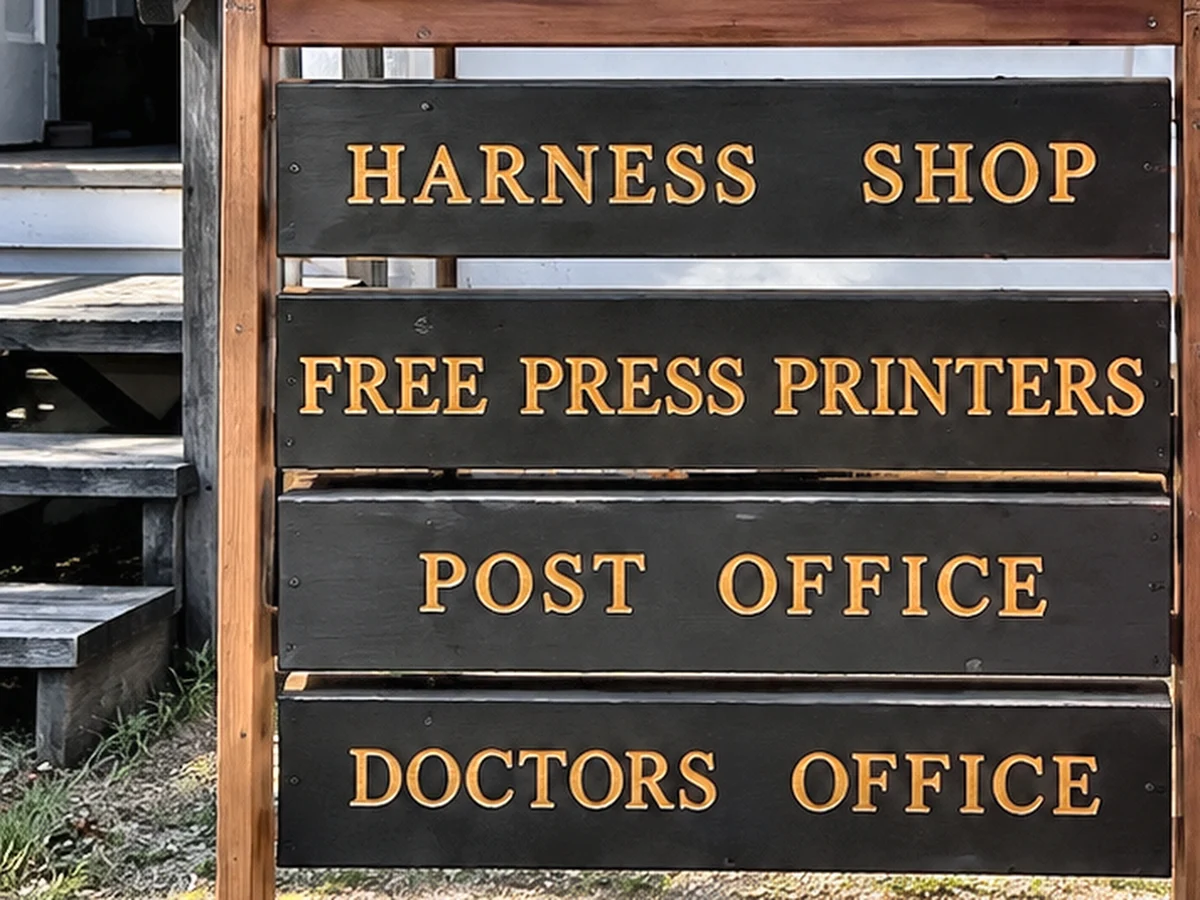
Painted Heritage Village sign board listing Harness Shop, Free Press Printers, Post Office and Doctors Office, standing on the grass beside the shop steps
Open for the weekend. The sign board on the grass outside the shops lists what waits behind the door: the harness shop, Free Press Printers, the post office, and the doctor’s office. Four trades under one roof.

The Heritage Village

Four trades under one roof
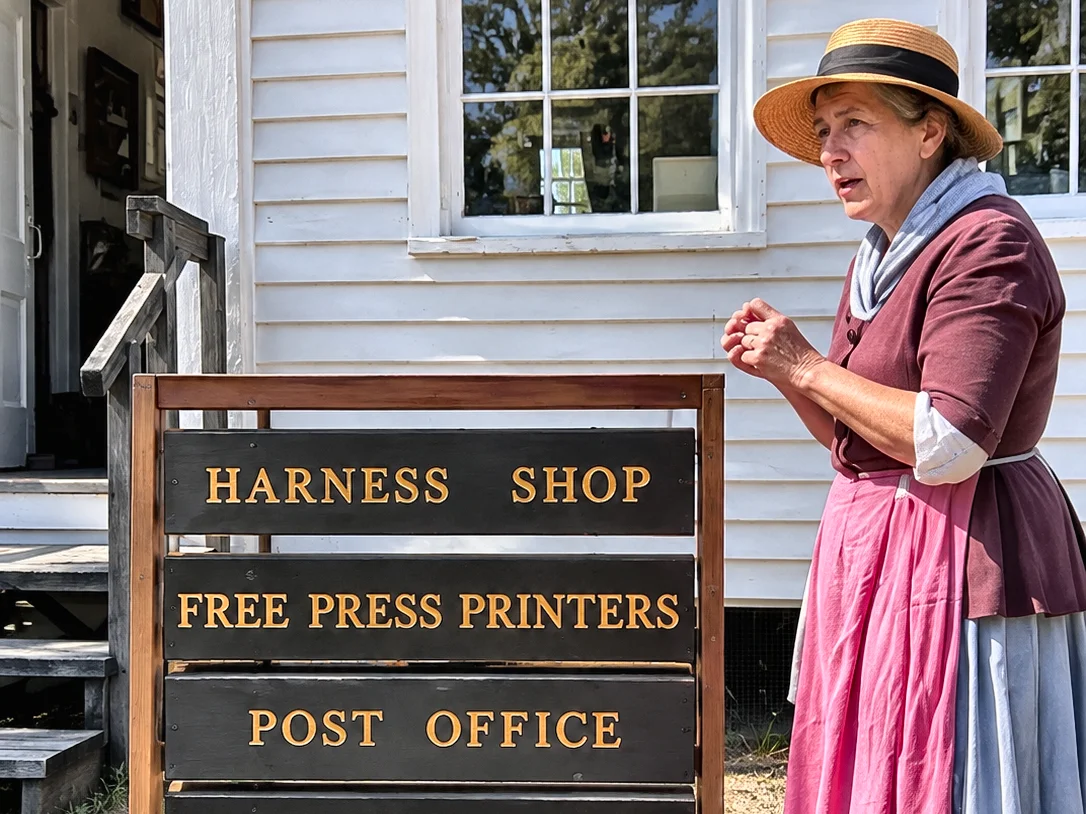
The Heritage Village sign board standing outside the white clapboard shop building
Outside the shops. The board stands on the grass by the steps, where anyone walking the Village can read the day’s four trades at a glance.
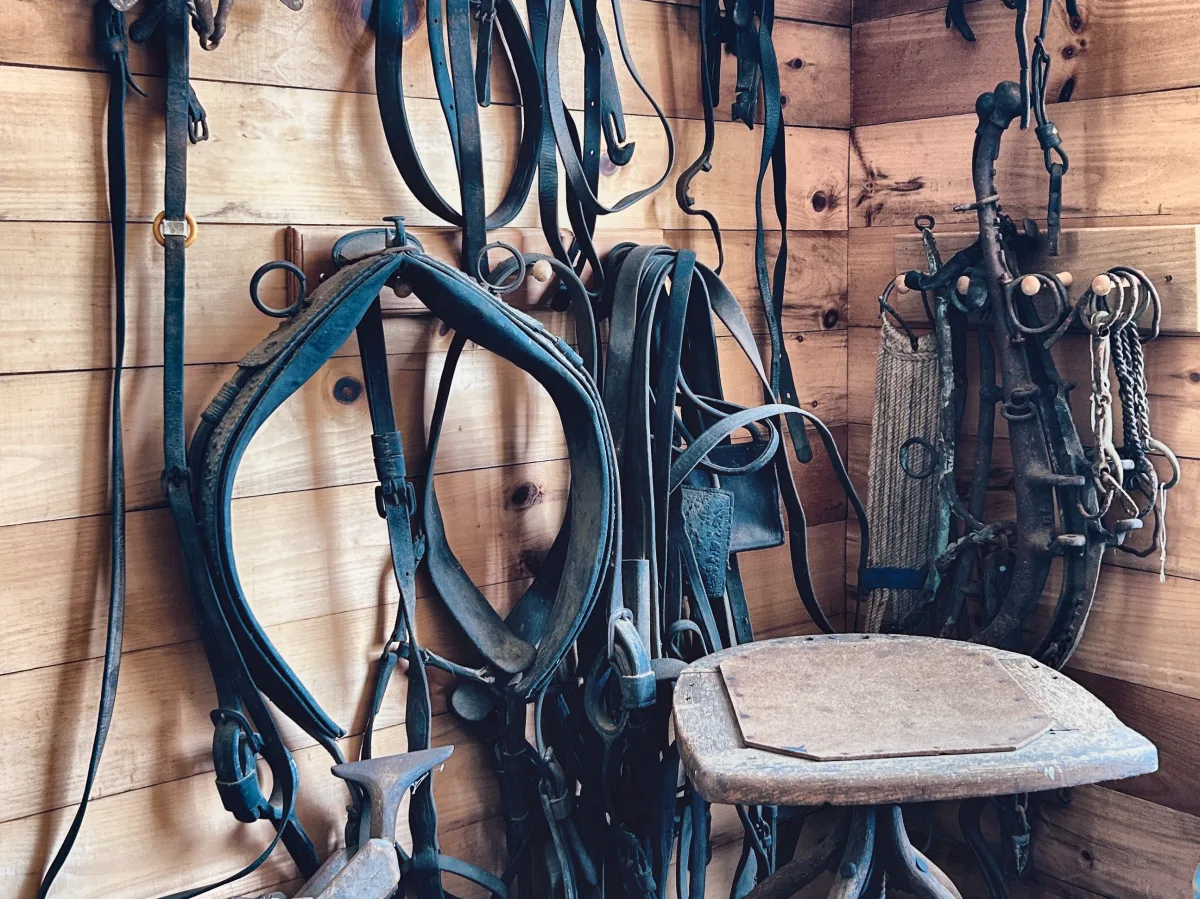
Wall of leather harness, bridles and collars above a worn wooden stool
The harness shop. Bridles, collars and traces hung where the maker could reach them. Every strap was cut to fit one animal, and the trade vanished with the working horse.
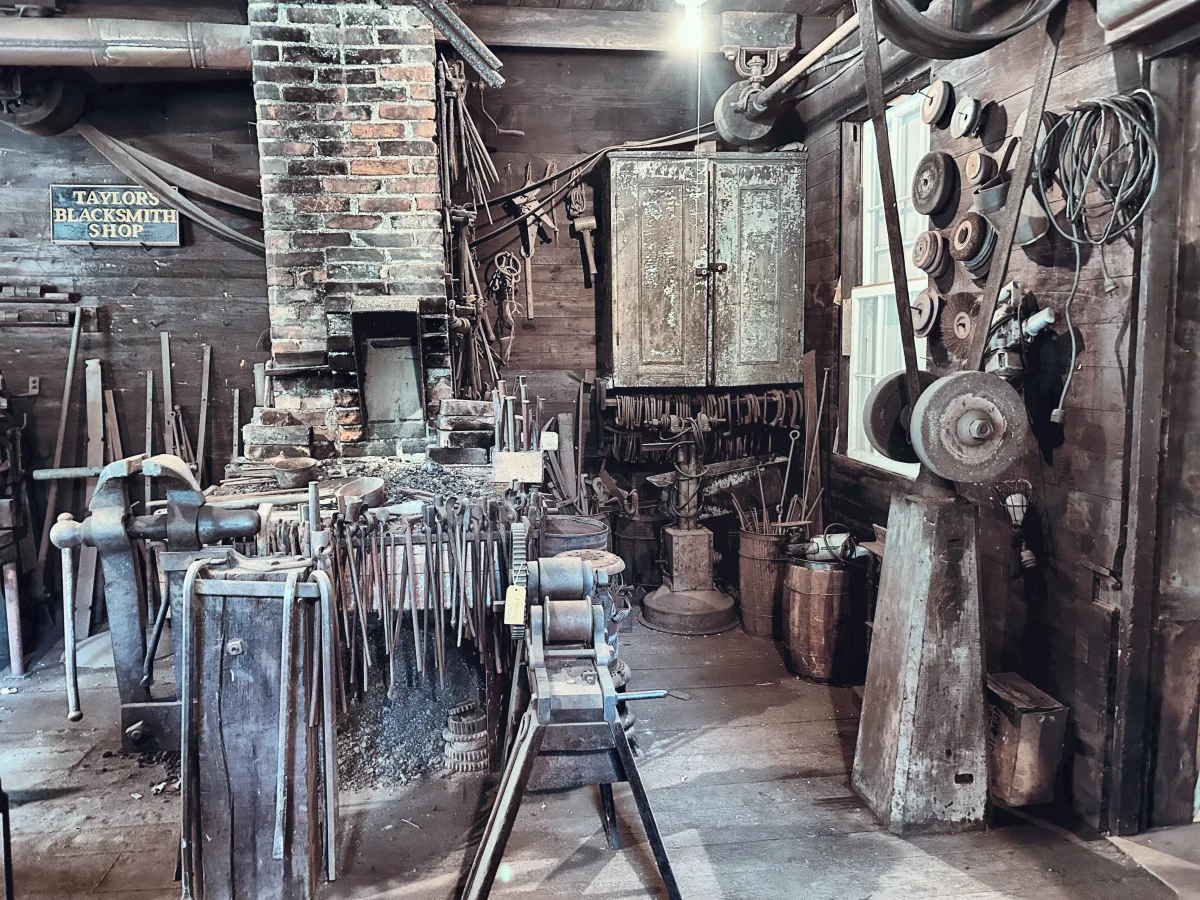
Blacksmith shop interior with tool rack, forge and anvil
Taylor’s Blacksmith Shop. Tongs racked in size order over the forge, the way a smith kept them so he never looked away from the fire.
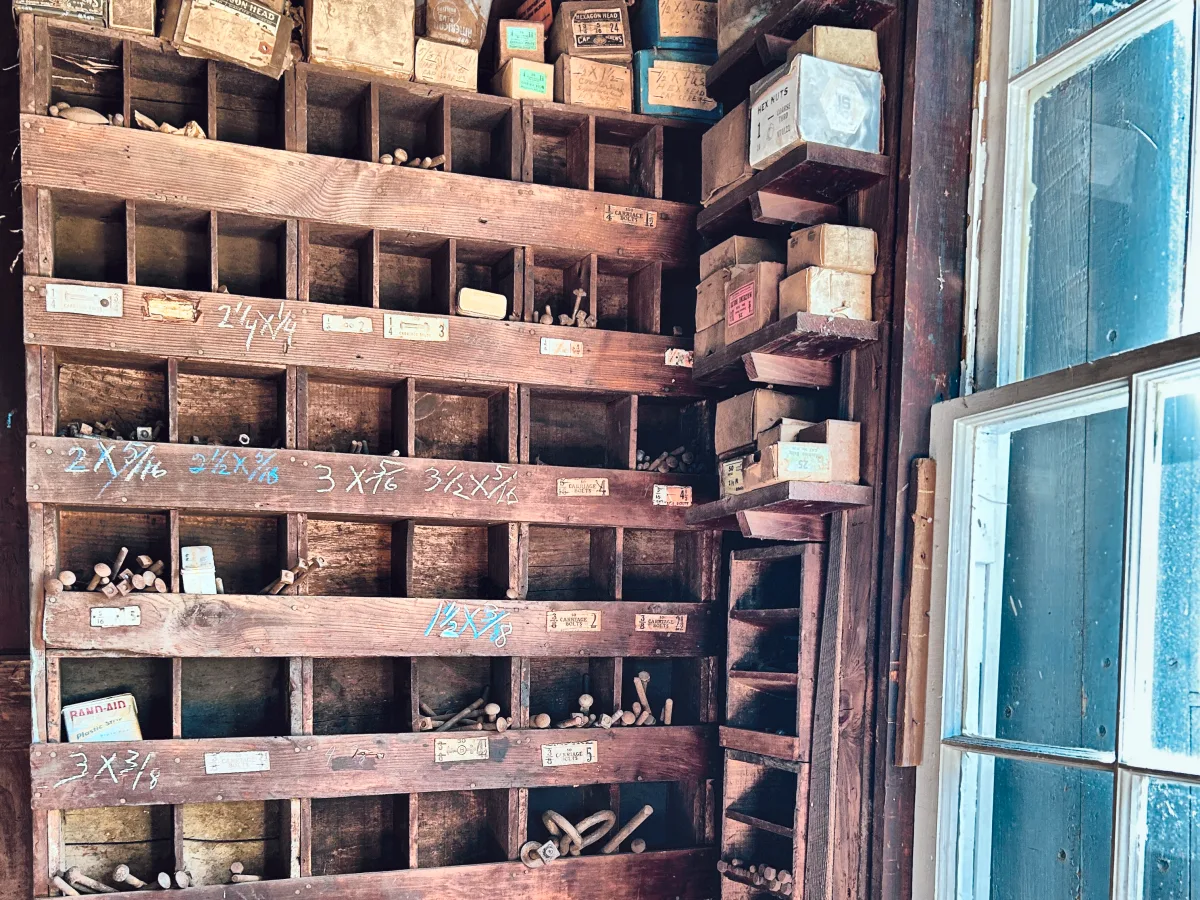
Wooden bins of bolts, nuts and cotter pins with old printed labels
Stove bolts and cotter pins. Sorted by size and thread. A shop this far from a supplier threw nothing away, because the next one was a day’s travel.
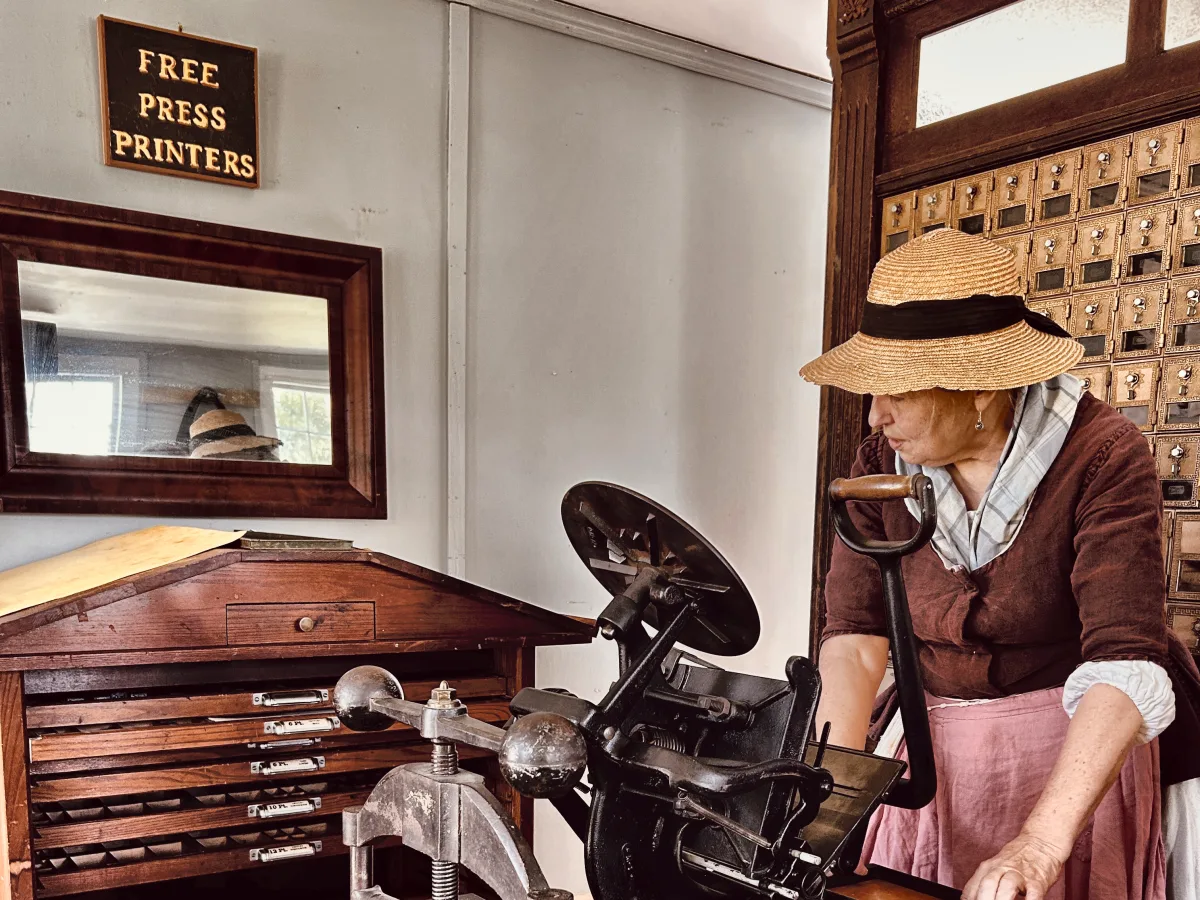
Curator Susan Reidy in period dress working the platen press beneath the Free Press Printers sign
Free Press Printers. Curator Susan Reidy in period dress at the platen press. Every ticket, handbill and town notice started here, a sheet at a time.
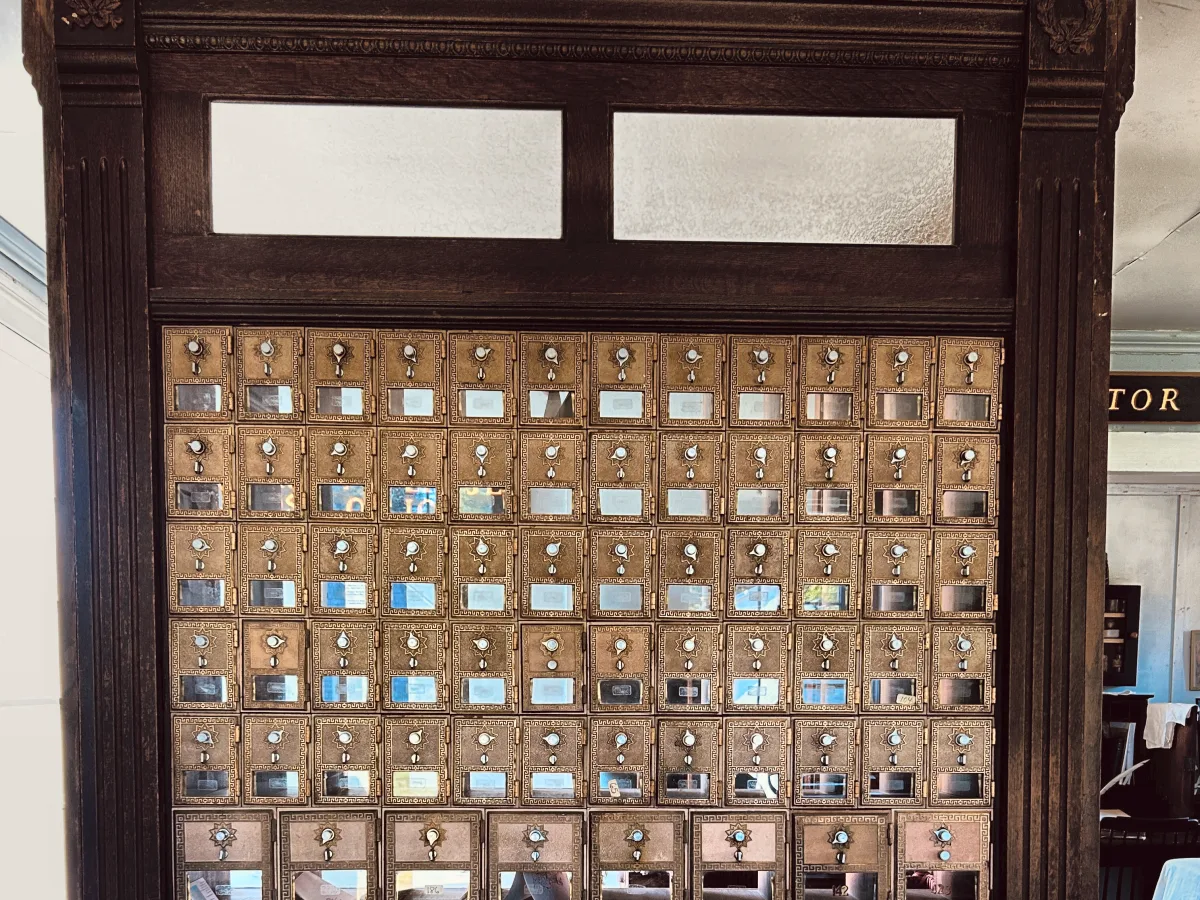
Tall oak post office box unit with rows of brass doors and glass windows
The boxes. Every family in the village had one of these small brass doors and knew its number by heart. The glass told you whether the walk was worth it.
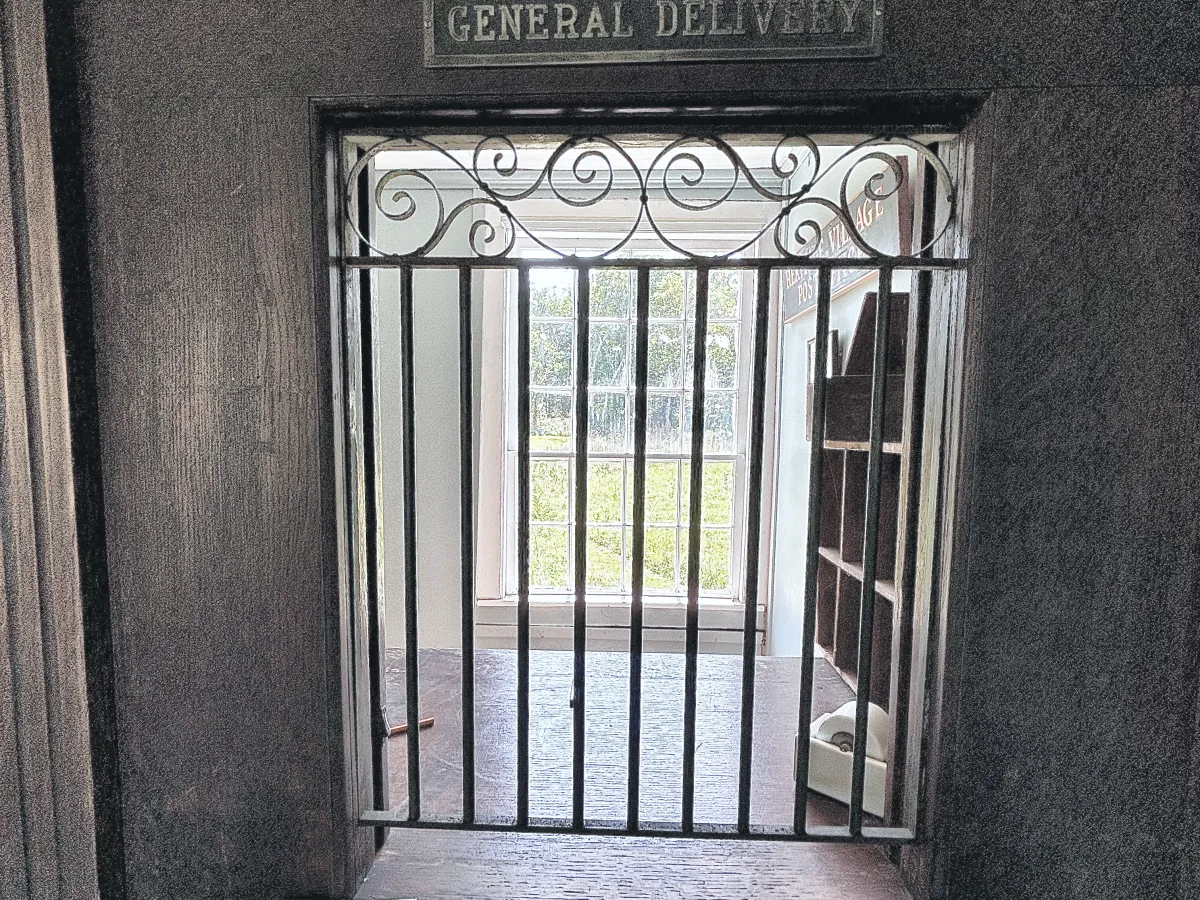
Post office service window with an iron grille beneath signs reading Stamps and General Delivery
Stamps and General Delivery. Two signs, one window, and the grille the postmaster worked behind.
Doorway with a painted sign reading Doctor above it
One word on the door. No name, no hours, no appointment. In a village this size nobody needed telling which doctor.
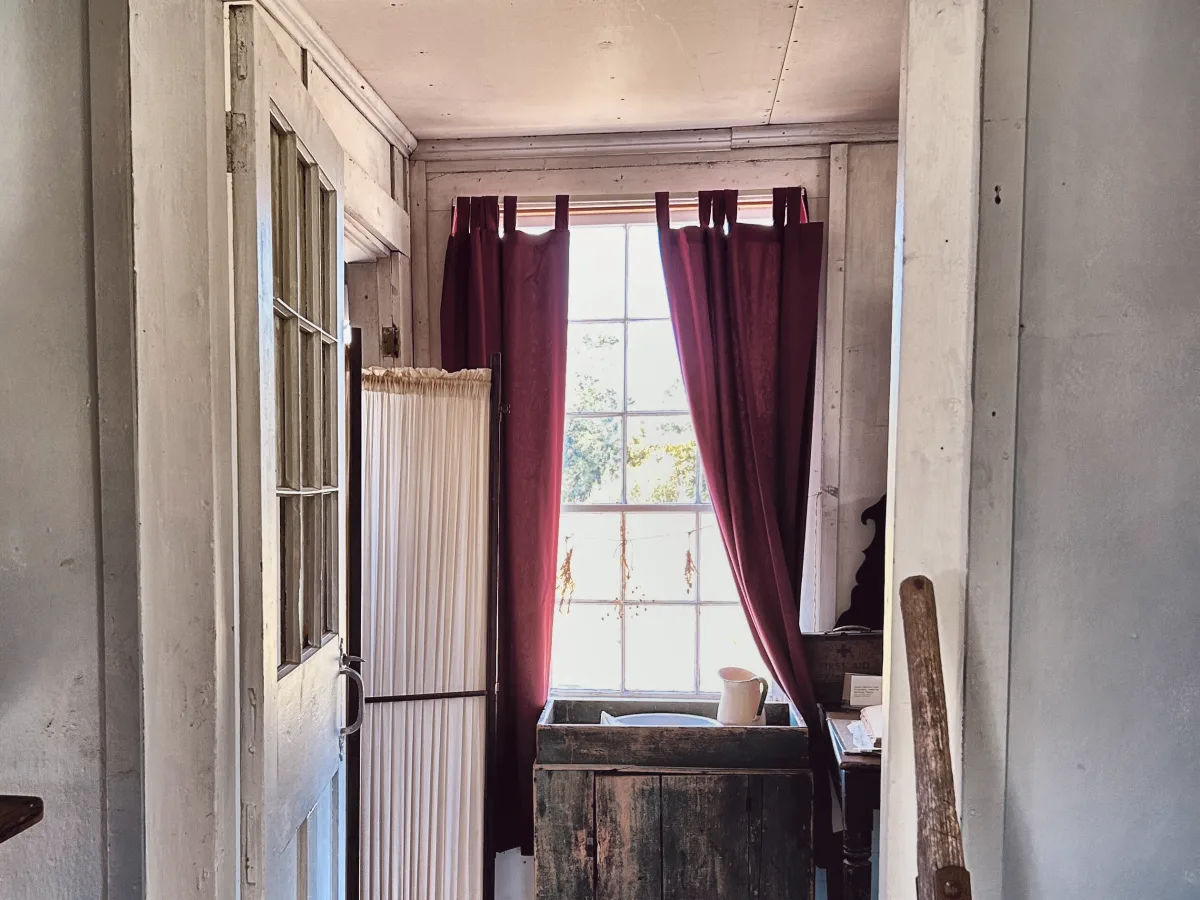
Doctor’s office with washstand, desk, framed anatomical prints and a wall telephone
The doctor’s office. A washstand, a desk, a telephone. In a town this size the doctor came to you more often than you went to him.
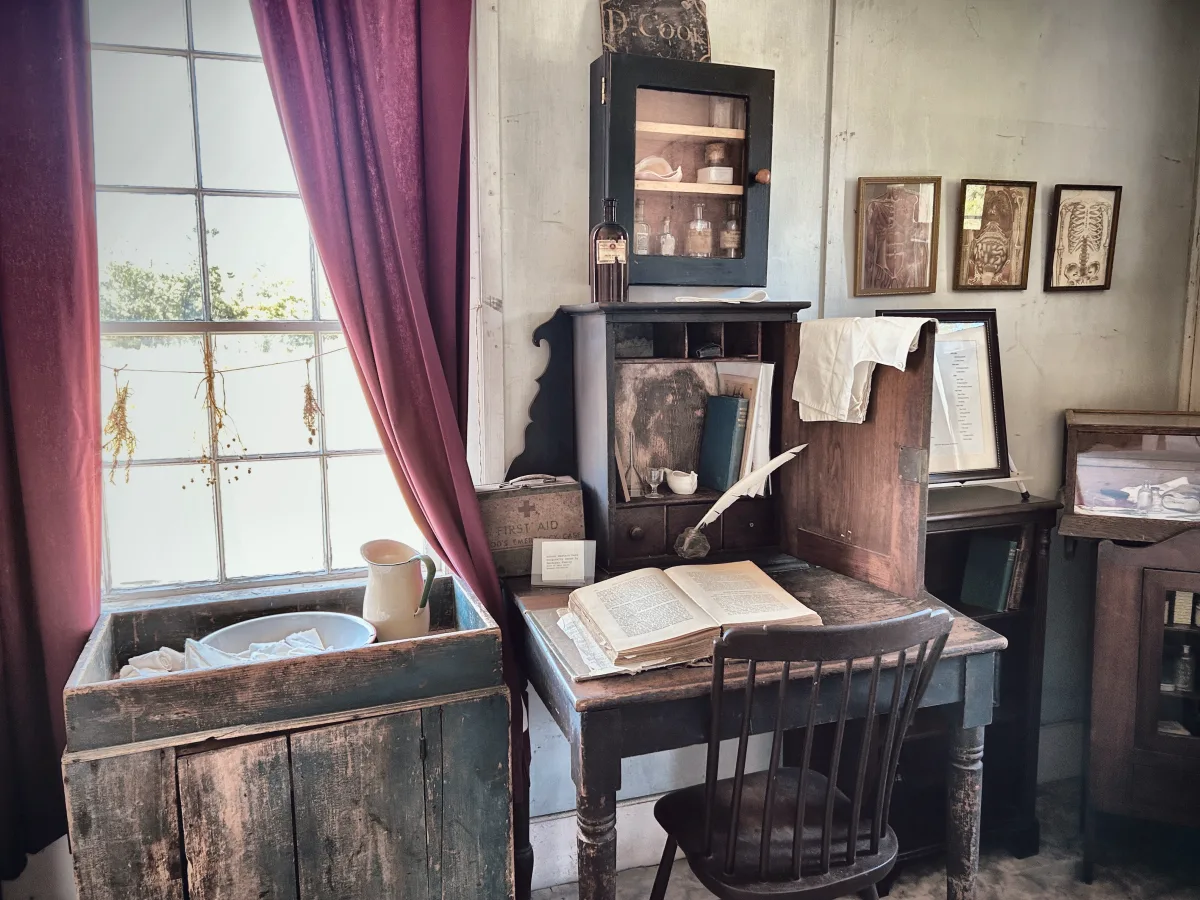
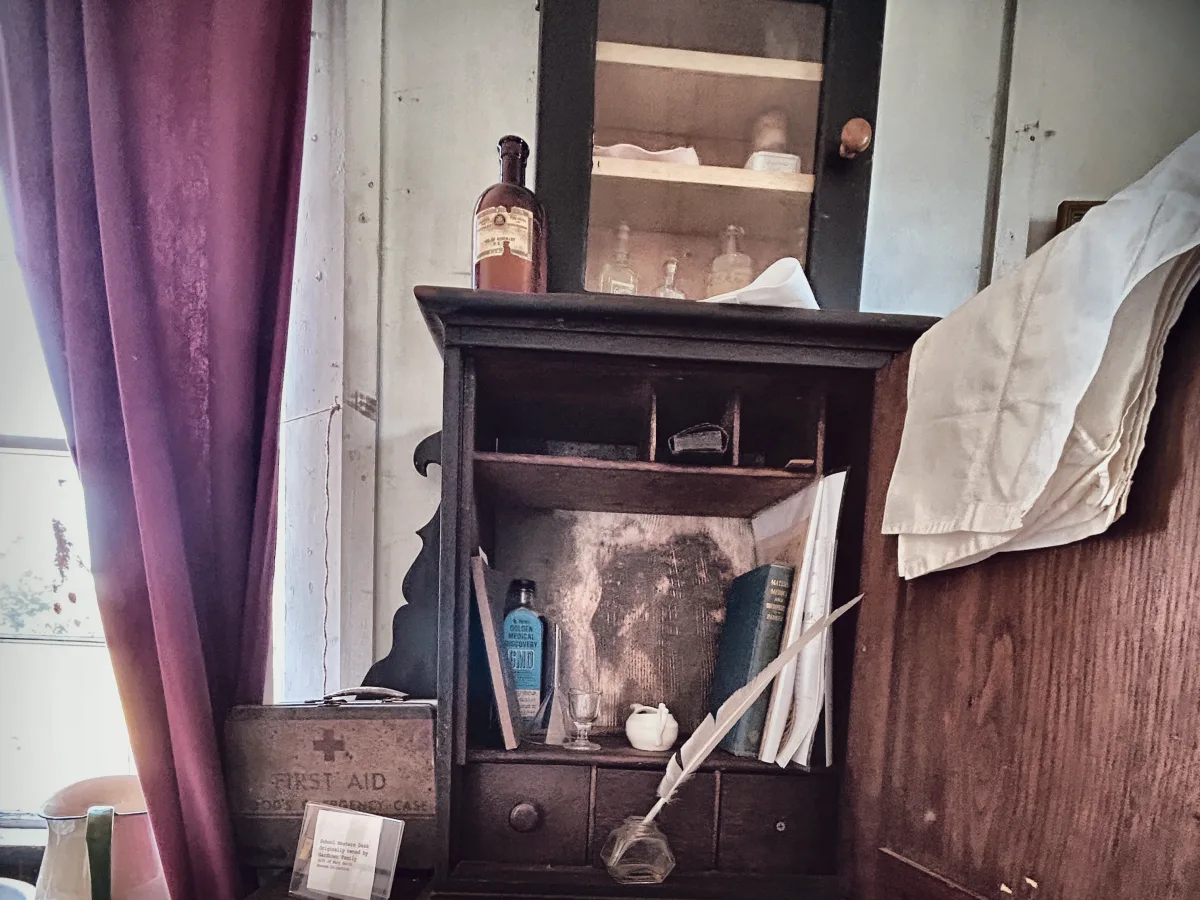
School master’s desk with quill, inkwell, medicine bottles and an open medical book
The school master’s desk. Originally owned by the Gardiner family and given to the museum by Mary Smith, it serves here as the doctor’s desk.
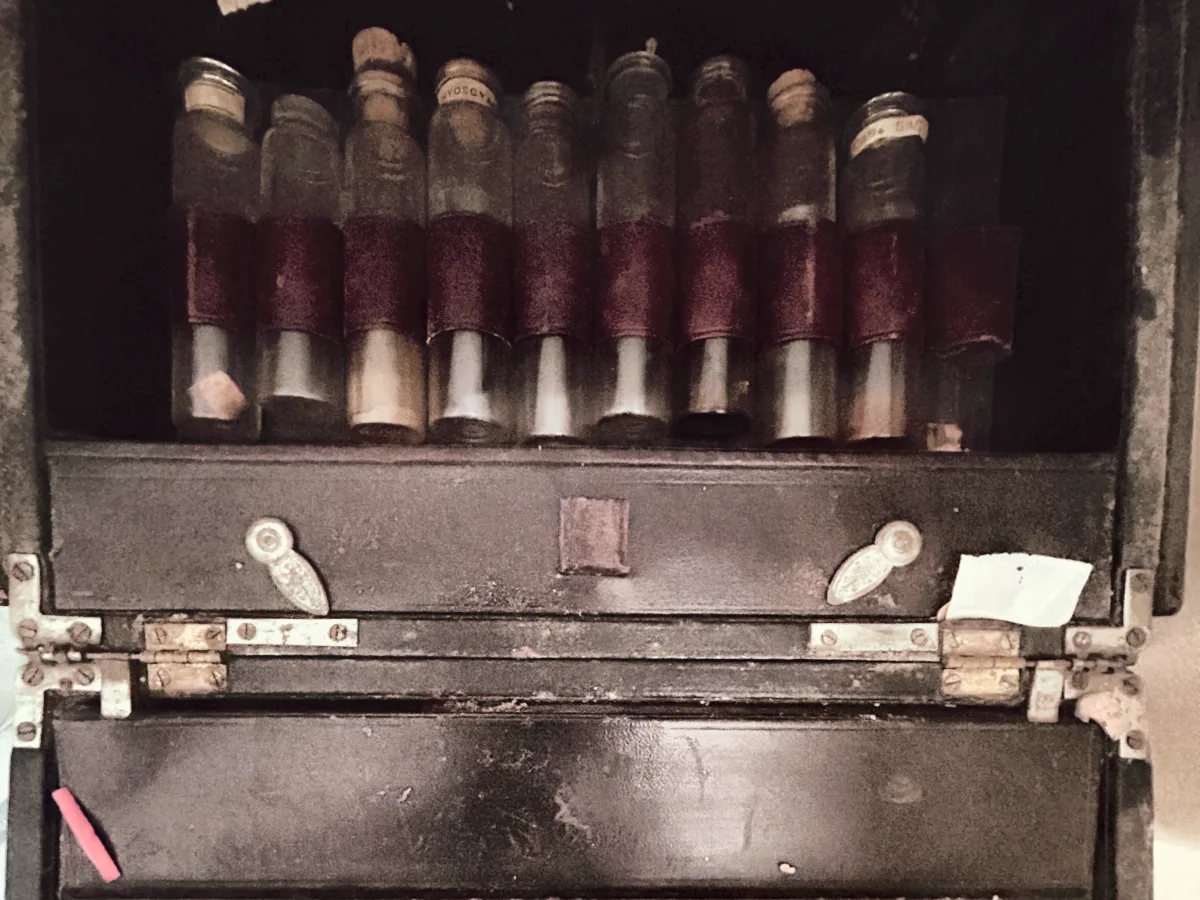
Fitted case of glass medicine vials with cork stoppers
The medicine case. Accession 76.1.2. A fitted row of stoppered vials, sized to ride in a bag on a house call.
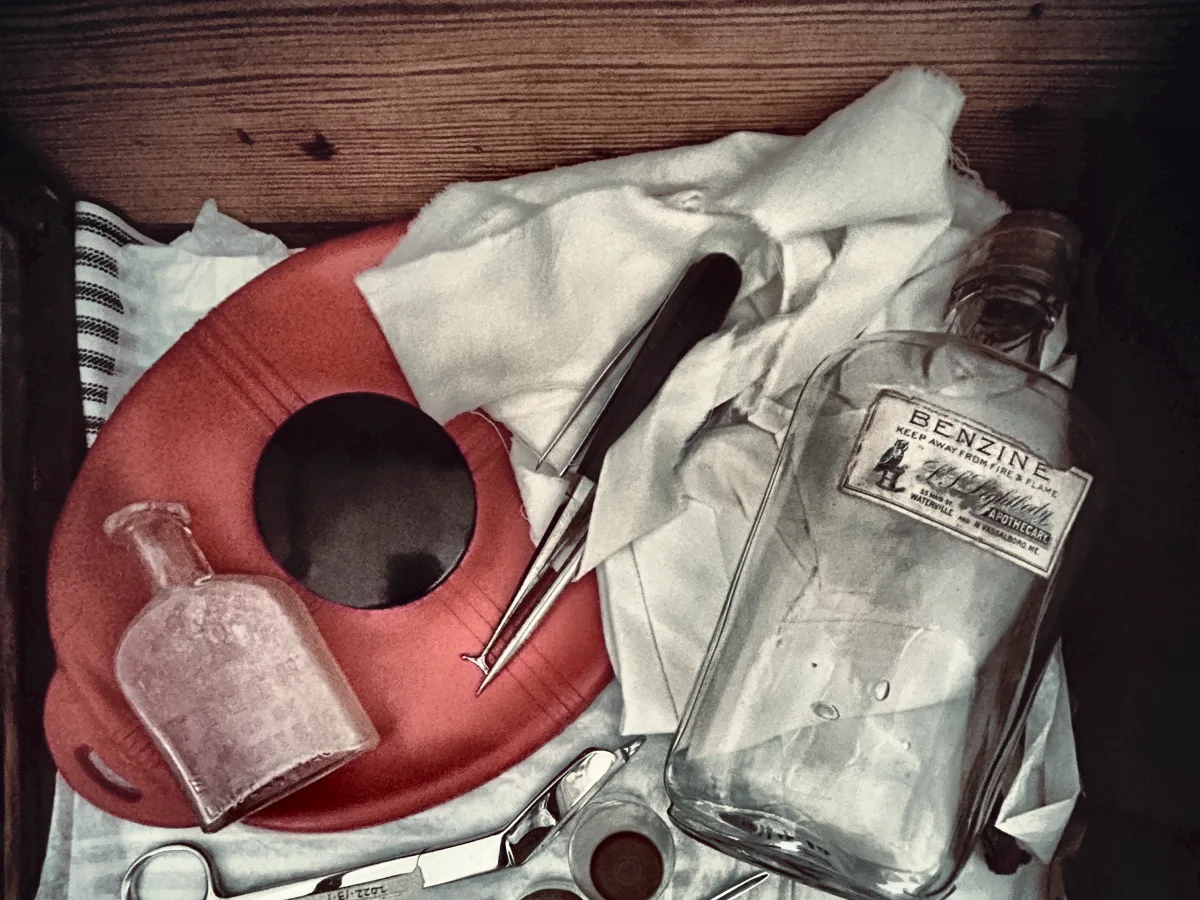
Surgical instruments, a glass benzine bottle and folded cloths in a tray
A local label. The benzine bottle reads J. L. Lightbody Apothecary, 55 Main Street, Waterville and North Vassalboro. The supplies came from the next village over.
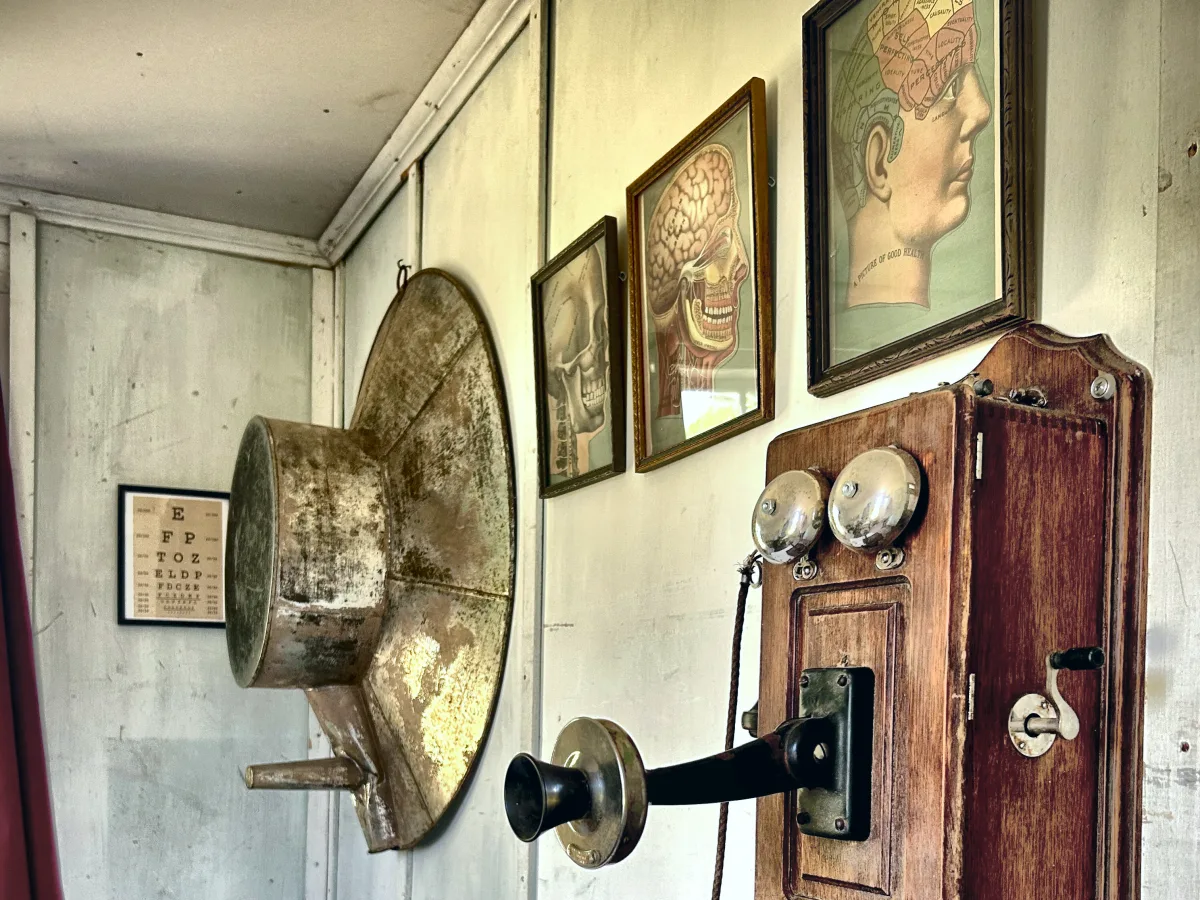
Oak crank wall telephone beside a stand up bathtub hung on the wall, an eye chart and framed anatomical prints
Crank, eye chart, and a bathtub on the wall. The oval on the left is not a lamp. It is a stand up bathtub, hung out of the way until Saturday night, when it came down and got filled a kettle at a time.
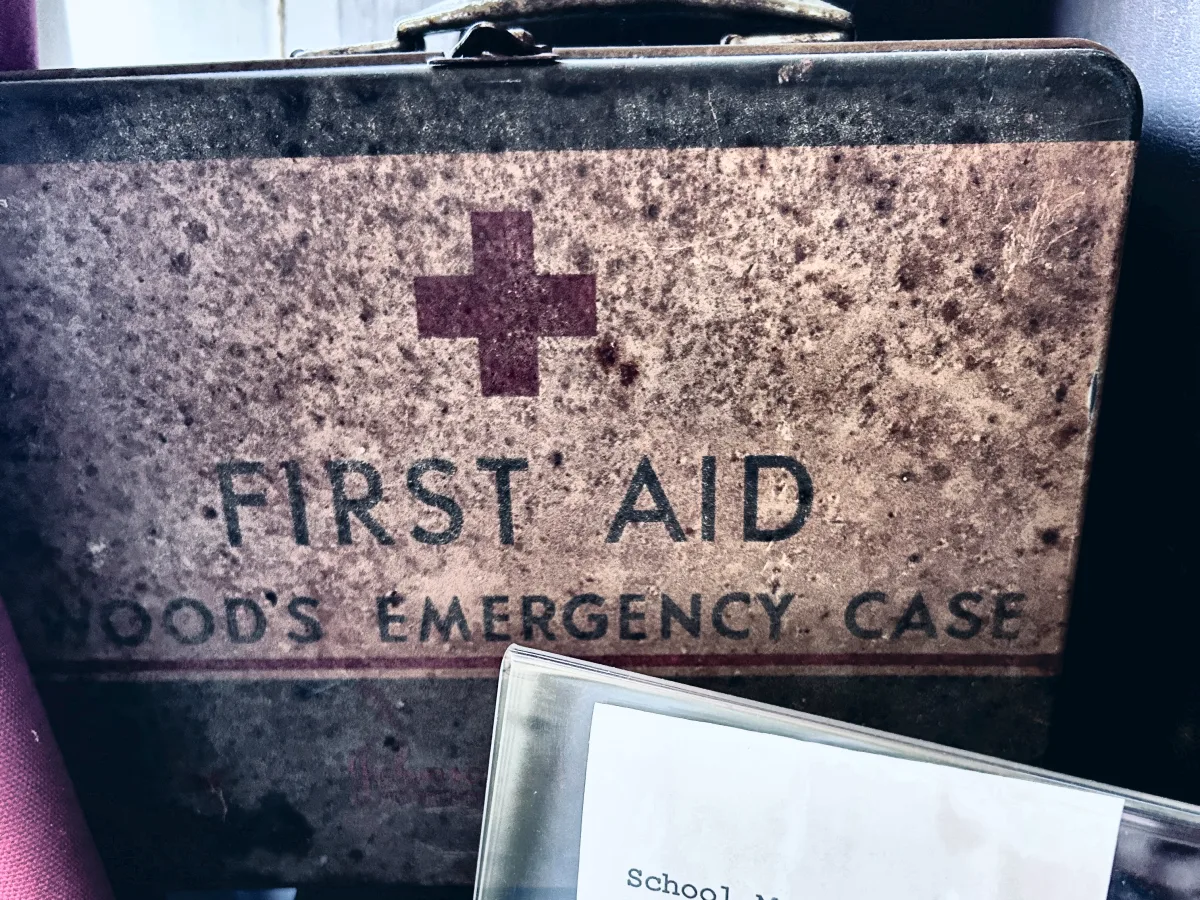
Metal first aid case marked Wood’s Emergency Case beside a typed label
Wood’s Emergency Case. A metal first aid kit of the kind kept in a mill, a garage, or a school.
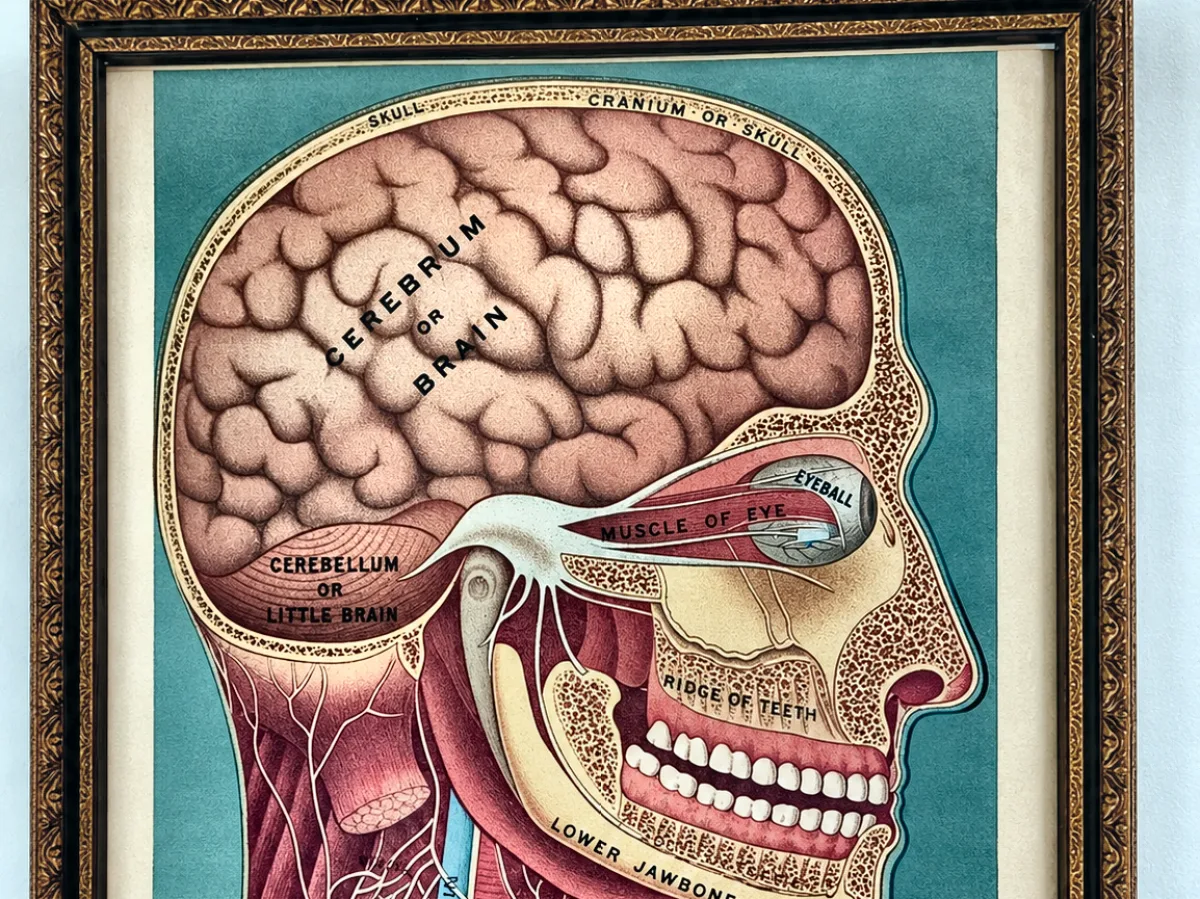
Framed anatomical print showing a cross section of the human head
On the wall. Anatomical prints did the explaining, since most patients had never seen inside a body and never would.
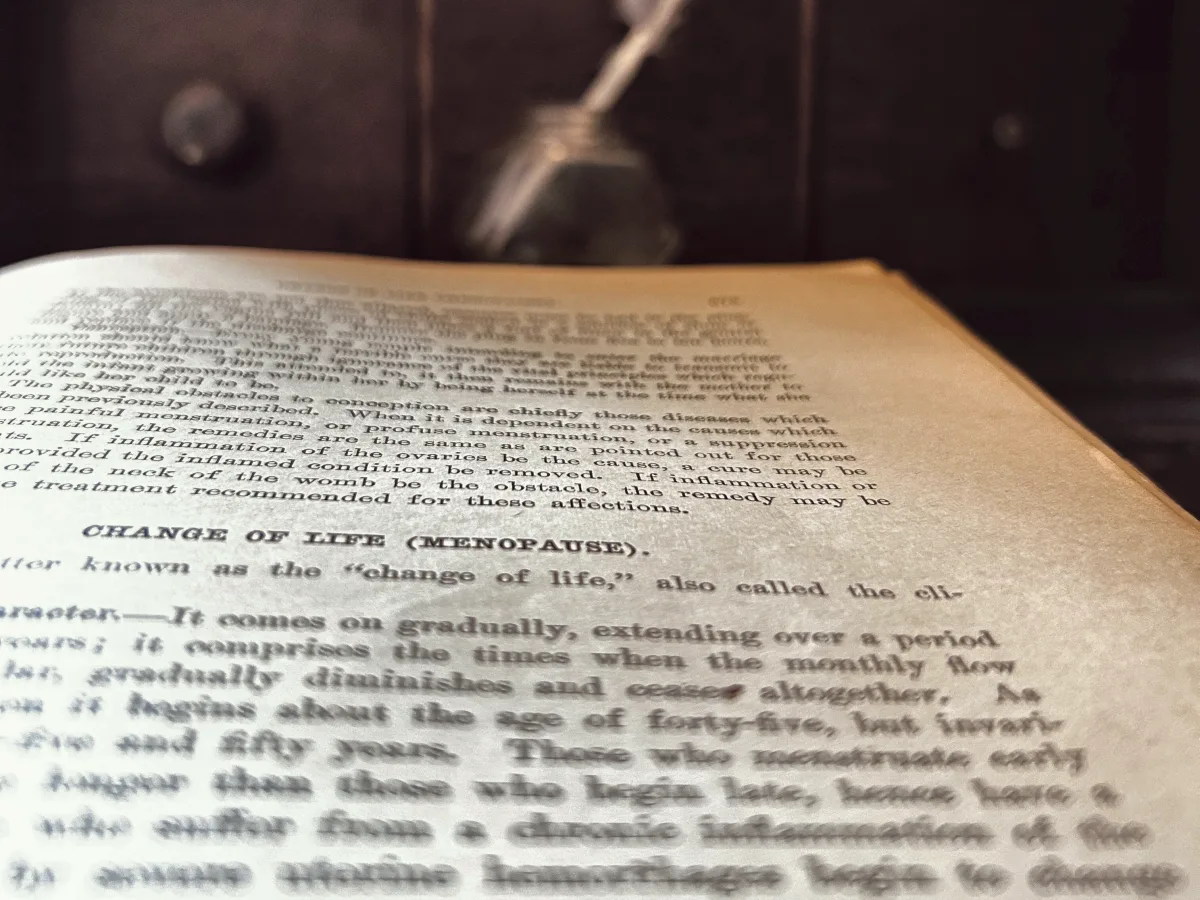
Open page of a period home medical book headed Change of Life
What the book said. A household medical volume, open to the chapter on the change of life. The tone tells you as much as the advice does about how medicine once spoke to women.
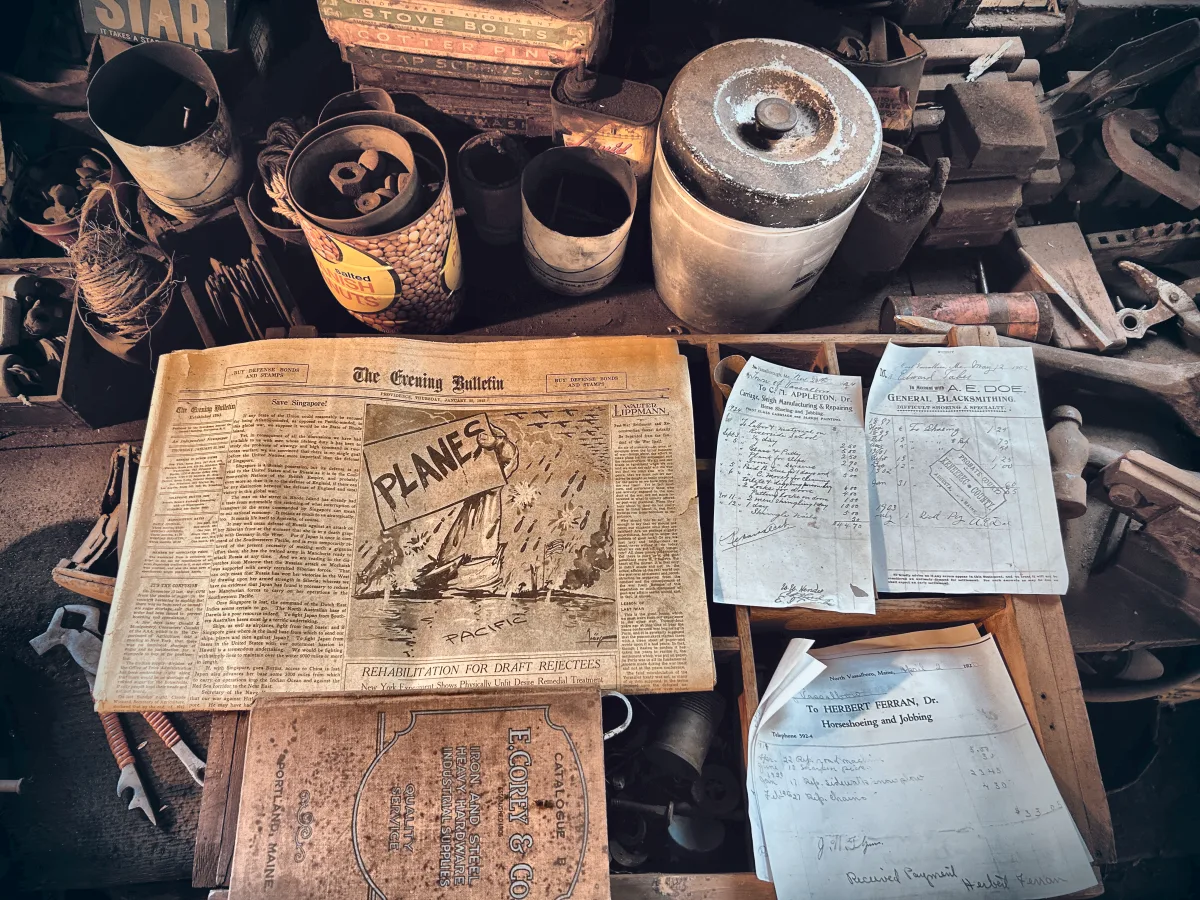
Handwritten blacksmith bills and a 1942 newspaper spread on a workbench

The town’s account with the blacksmith

Three bills lie open on the bench, all made out to people and bodies in this town. A. E. Doe, General Blacksmithing, difficult shoeing a specialty, billing Edward Taber in 1902. C. M. Appleton, carriage and sleigh manufacturing and repairing, billing the Town of Vassalboro in 1924. Herbert Ferran, horseshoeing and jobbing, North Vassalboro, telephone 592-4.

Repairing road machine
Repairing sidewalk snowplow
Shingle nails
Two men shingling, one day

The newspaper beneath them is the Providence Evening Bulletin for Thursday, January 22, 1942, carrying war news and a Buy Defense Bonds line across the masthead.
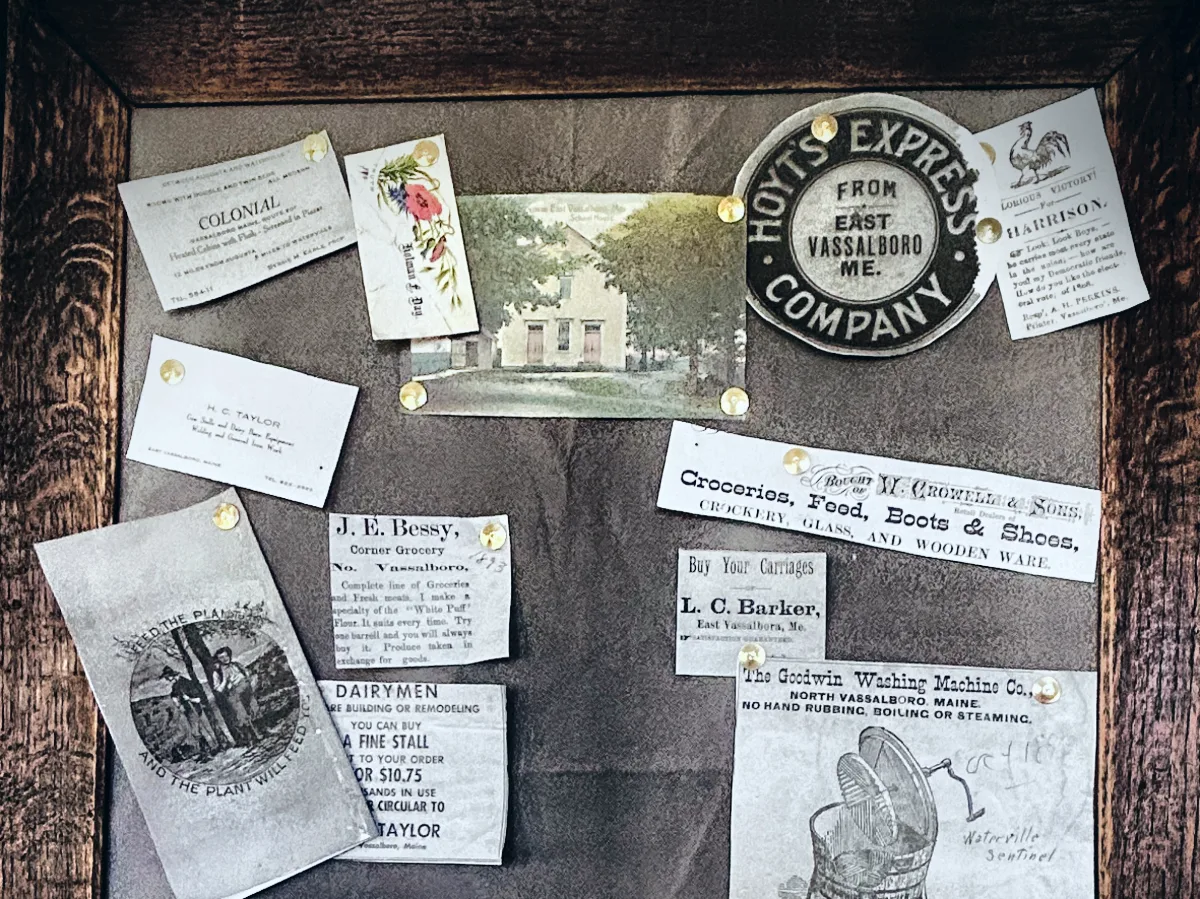
Framed display of nineteenth century Vassalboro business cards and advertisements

A directory of shops that are gone

One frame beside the post office window holds most of the commercial life of two villages. Hoyt’s Express Company of East Vassalboro. G. H. Cates and Company, dry goods and ready made clothing. Grant Brothers, fine carriages and sleighs, North Vassalboro. J. E. Bessy’s corner grocery, a specialty made of White Puff flour. L. C. Barker, carriages. Fossett and Reed, brooms and brushes, Riverside.

The largest sheet advertises the Goodwin Washing Machine Company of North Vassalboro: no hand rubbing, boiling or steaming, ten dollars cash or eleven on the installment plan, agents wanted.

The Museum

Signs, uniforms, and the parlor
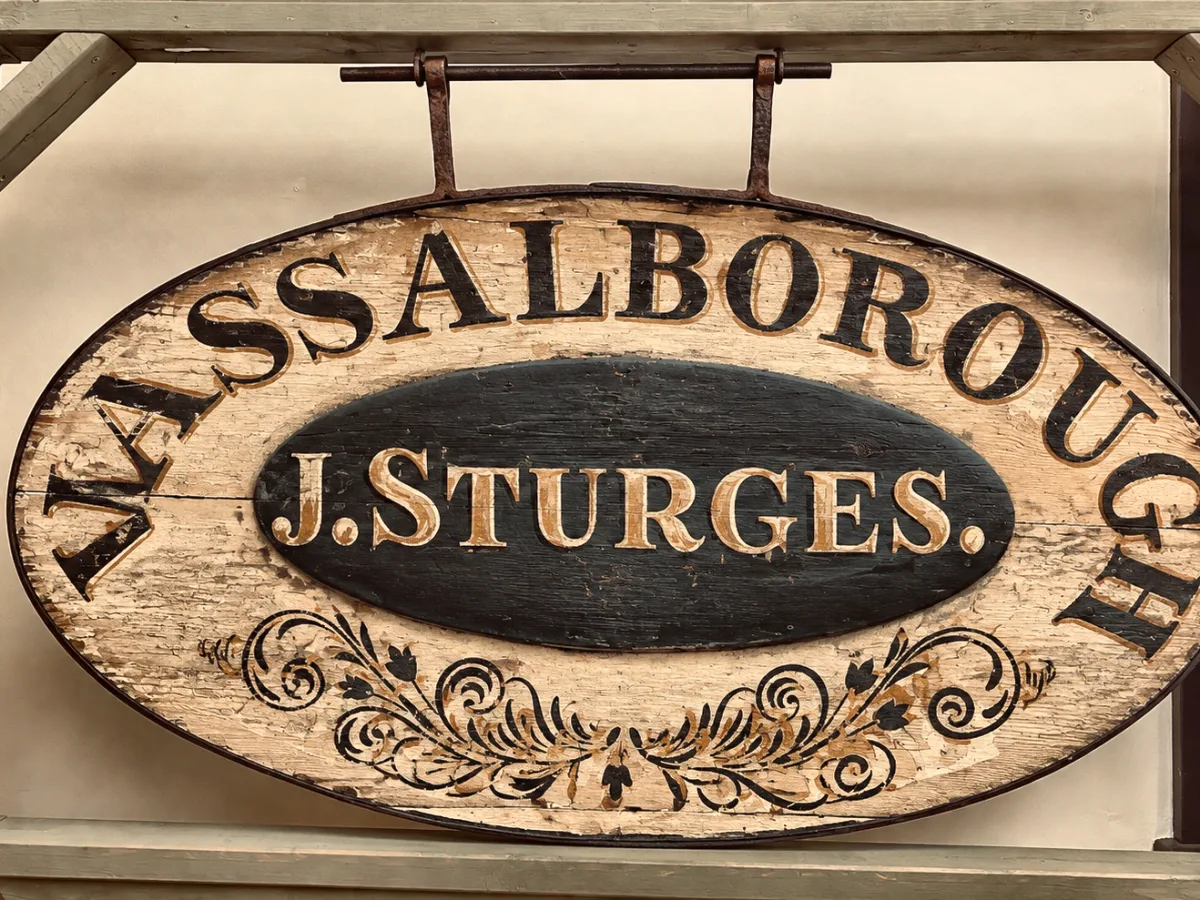
Oval hanging tavern sign reading Vassalborough, J. Sturges
Vassalborough, with the ugh. J. Sturges’s tavern board, hung where travelers could see it from the road. The older spelling dates the sign more reliably than anything else on it.
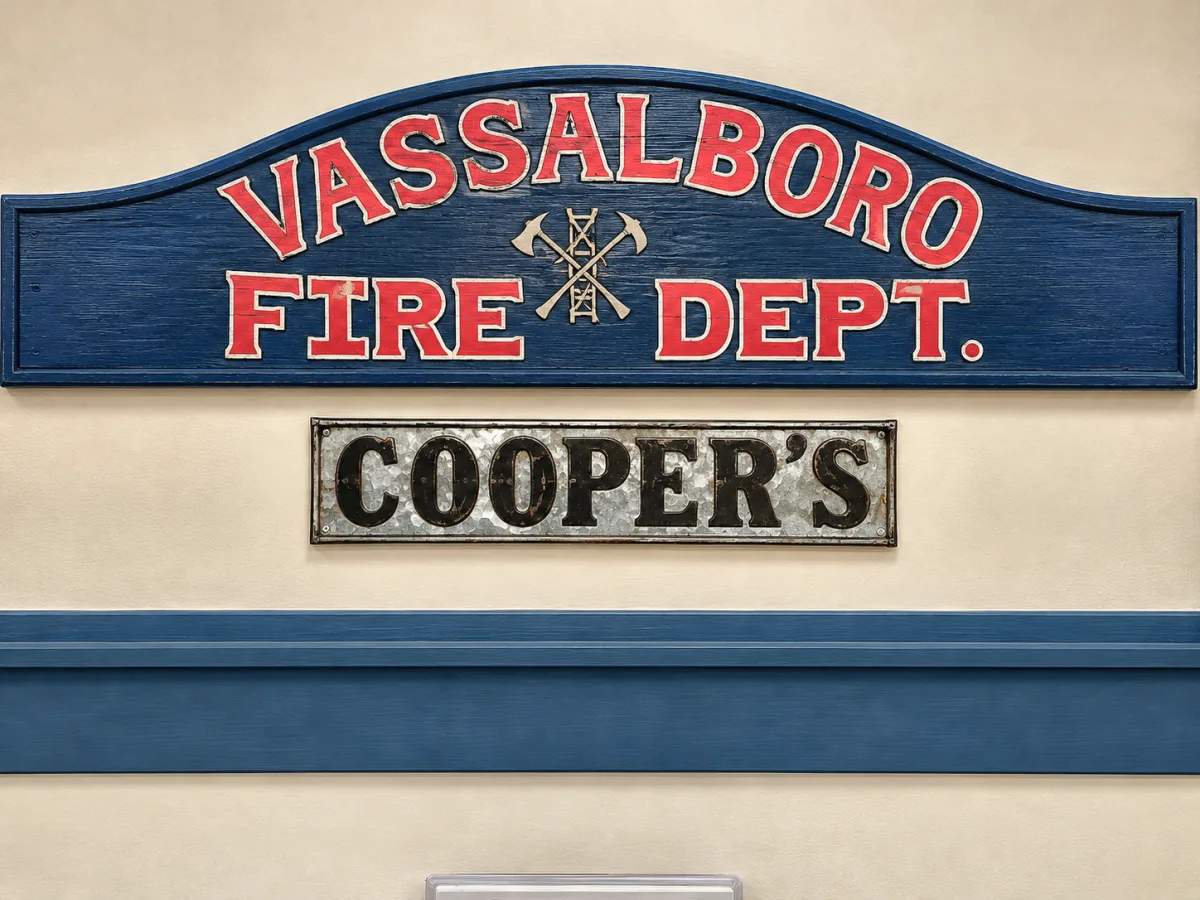
Painted Vassalboro Fire Dept. sign with crossed axes and ladder above a metal Cooper’s sign
Two signs, two institutions. The Fire Department board with its crossed axes and ladder, and the galvanized Cooper’s sign below it. Signs outlive the businesses that hung them.
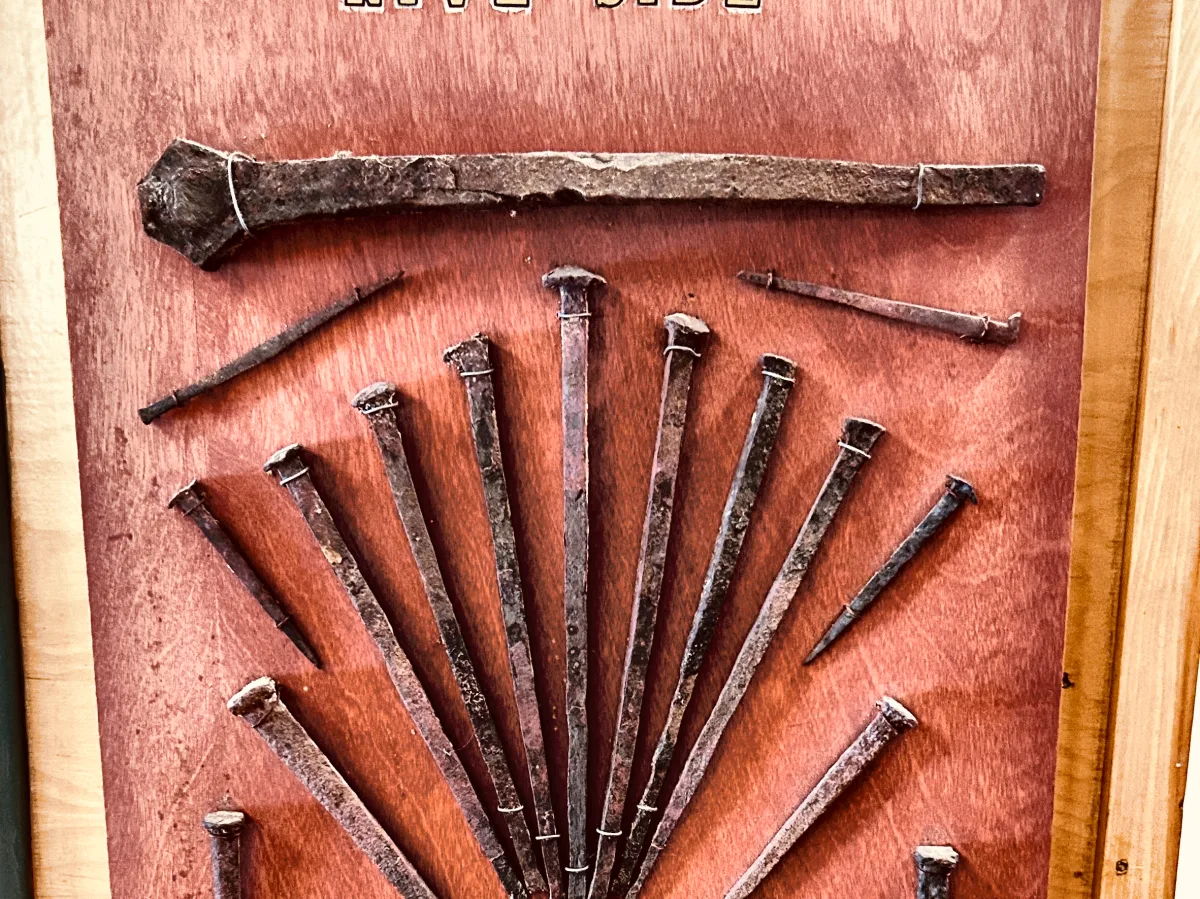
Display board of hand forged nails and a spike from the First Congregational Church at Riverside
The nails that held the church up. A spike and thirty odd hand forged nails, fanned out and labelled First Congo Church, Riverside. Each was drawn out on an anvil by hand, which is why a builder counted them.
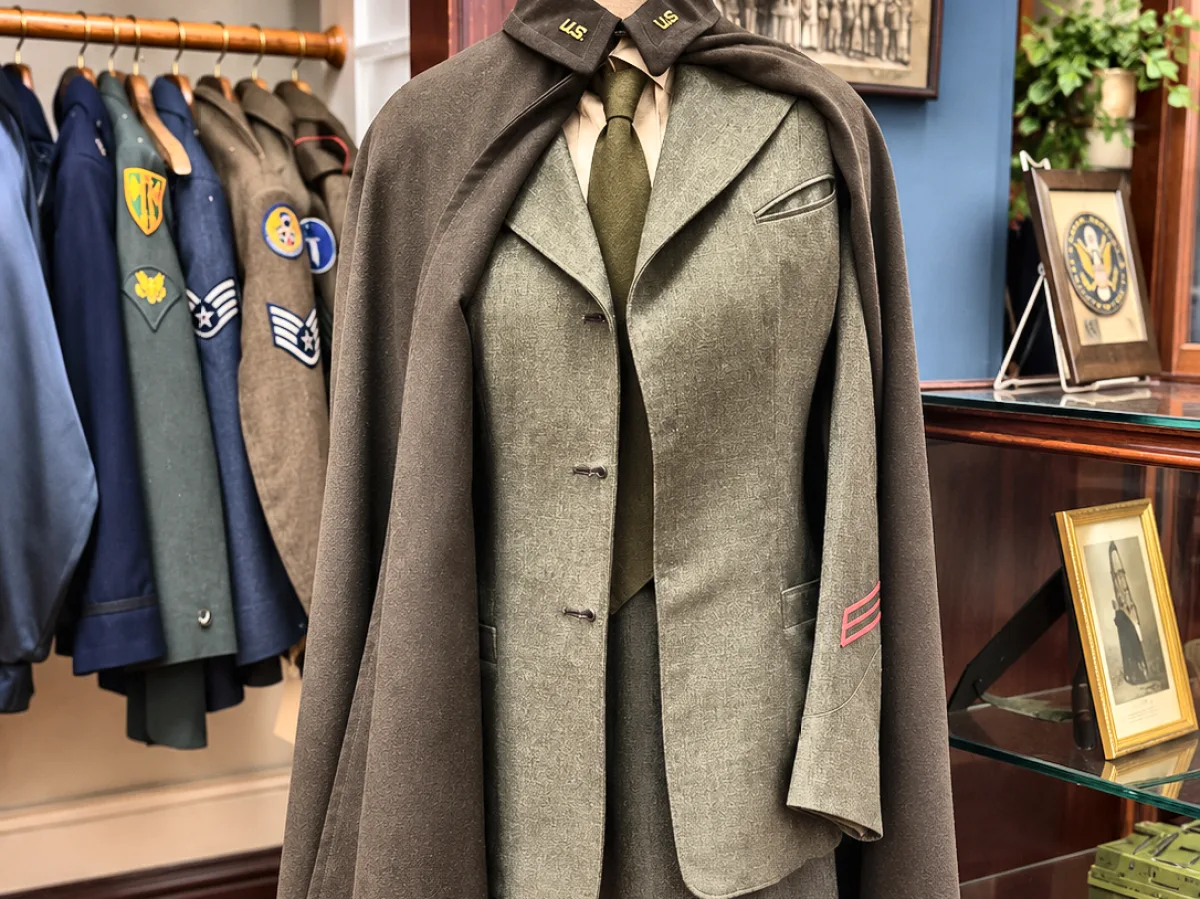
Marine Corps women’s service uniform with a wool nurse’s cape on a dress form, beside a rack of service uniforms
Two women, one dress form. The uniform belonged to Margaret Annette Lampson Davis, a technical sergeant in the Marines. The wool cape belonged to Mary Heeg, an Army nurse.
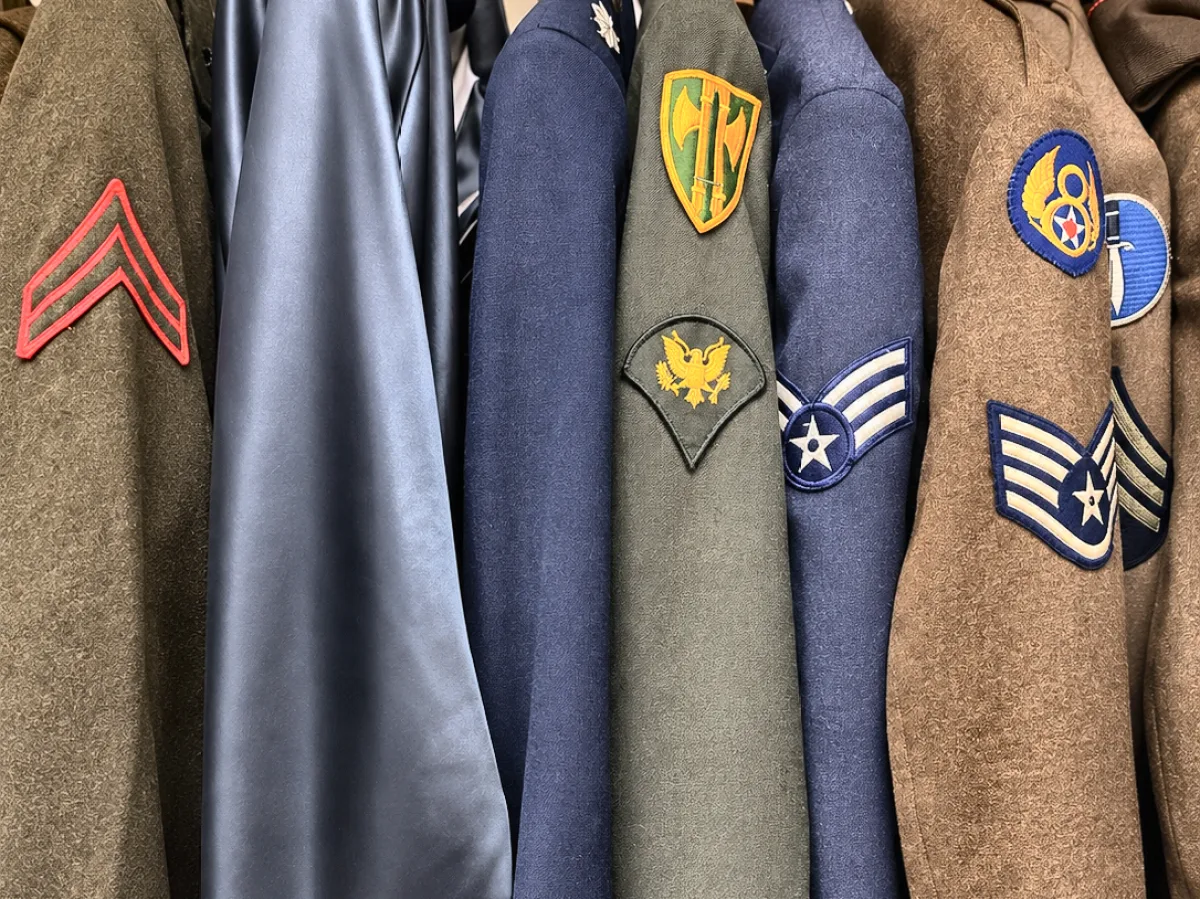
Rack of military uniforms showing Eighth Air Force, Military Police and Air Force insignia
Read the sleeves. The Eighth Air Force winged star, a Military Police shield, staff sergeant stripes. Each patch places a Vassalboro man or woman in a branch and a time.
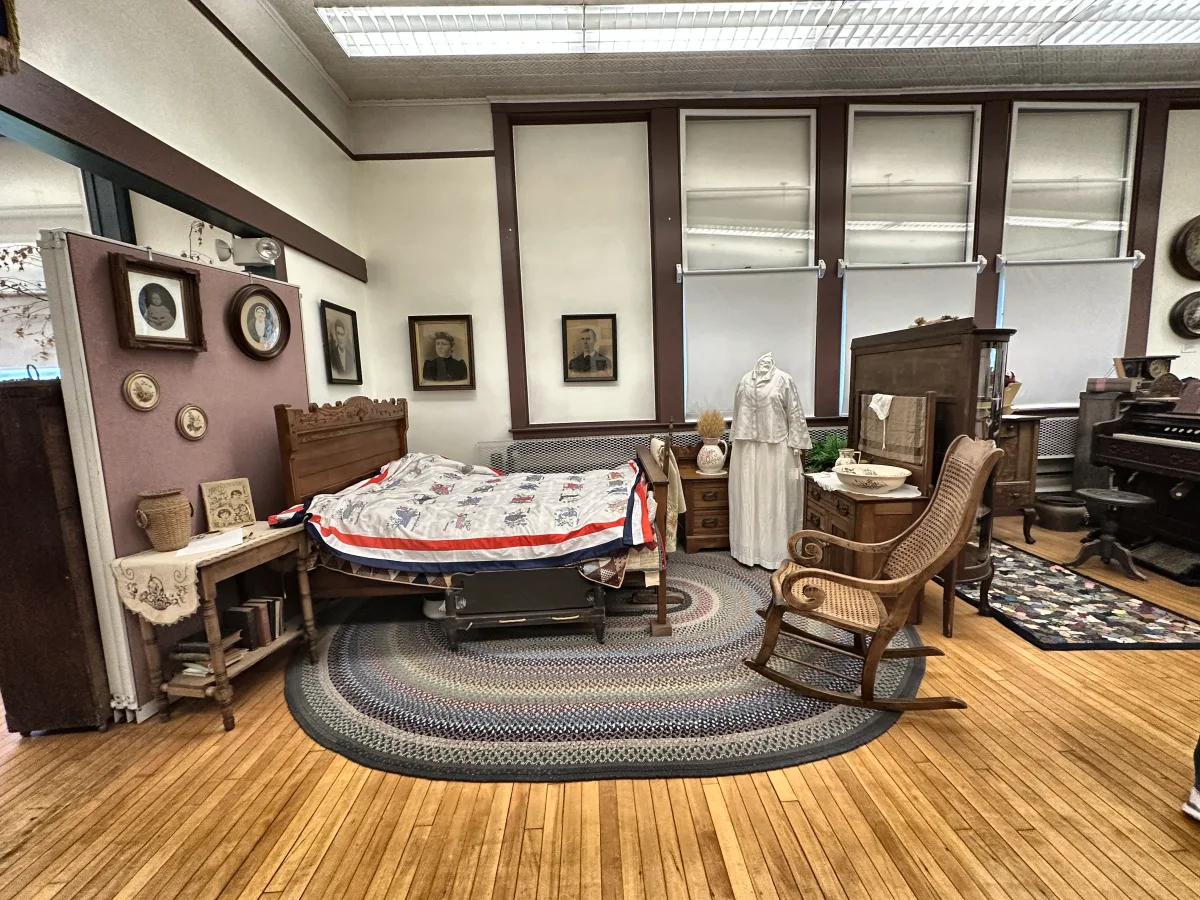
Period bedroom with a signature quilt on a carved bed, washstand, braided rug and rocking chair
The bedroom. A signature quilt over a carved bed, a white nightdress on the form, a braided rug. The portraits on the wall are from the Ronco family. The small stove at the foot of the bed is the only heat in the room.
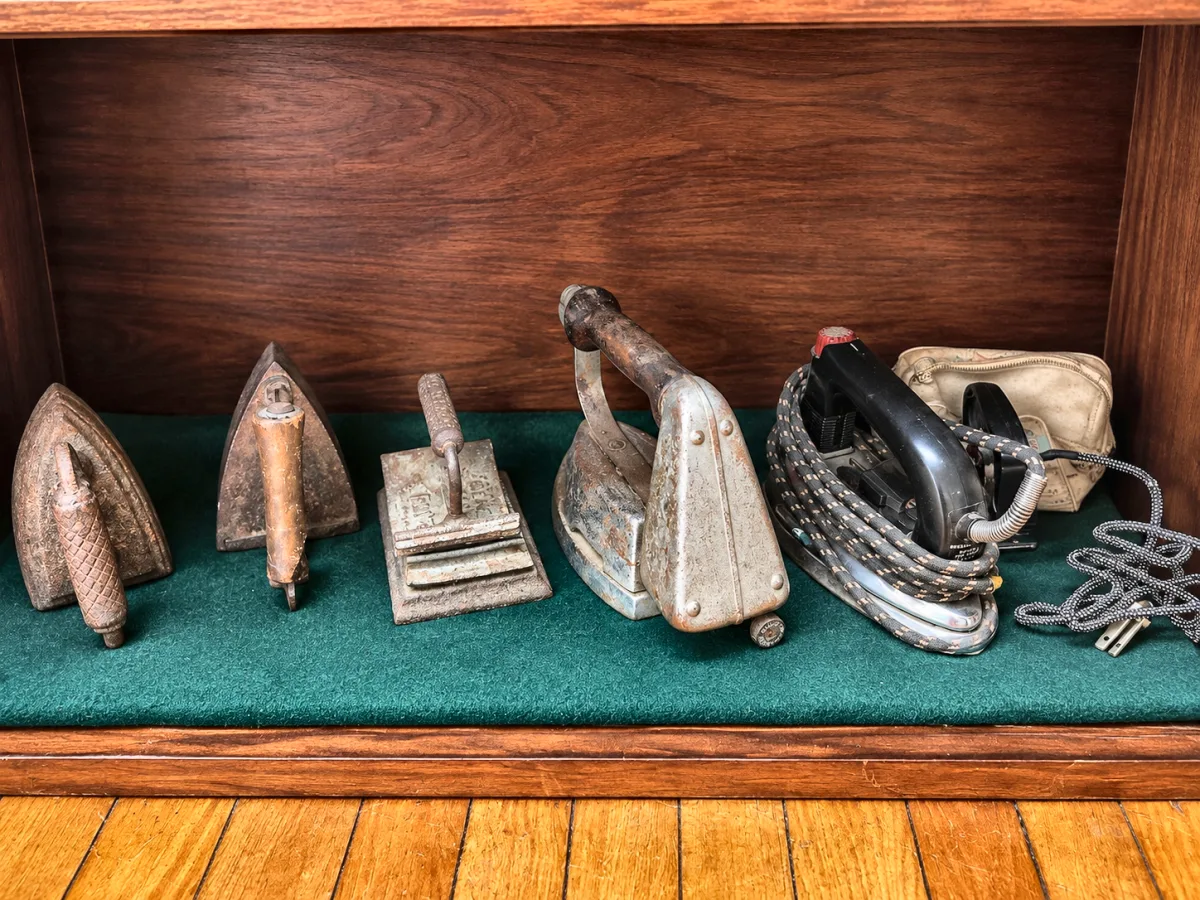
Row of five irons from cast iron flatirons to an early electric iron with a braided cord
A century of Monday. Two solid flatirons heated on the stove top, a detachable handle set so one handle served several bases, a gas iron, and an early electric with a braided cord.
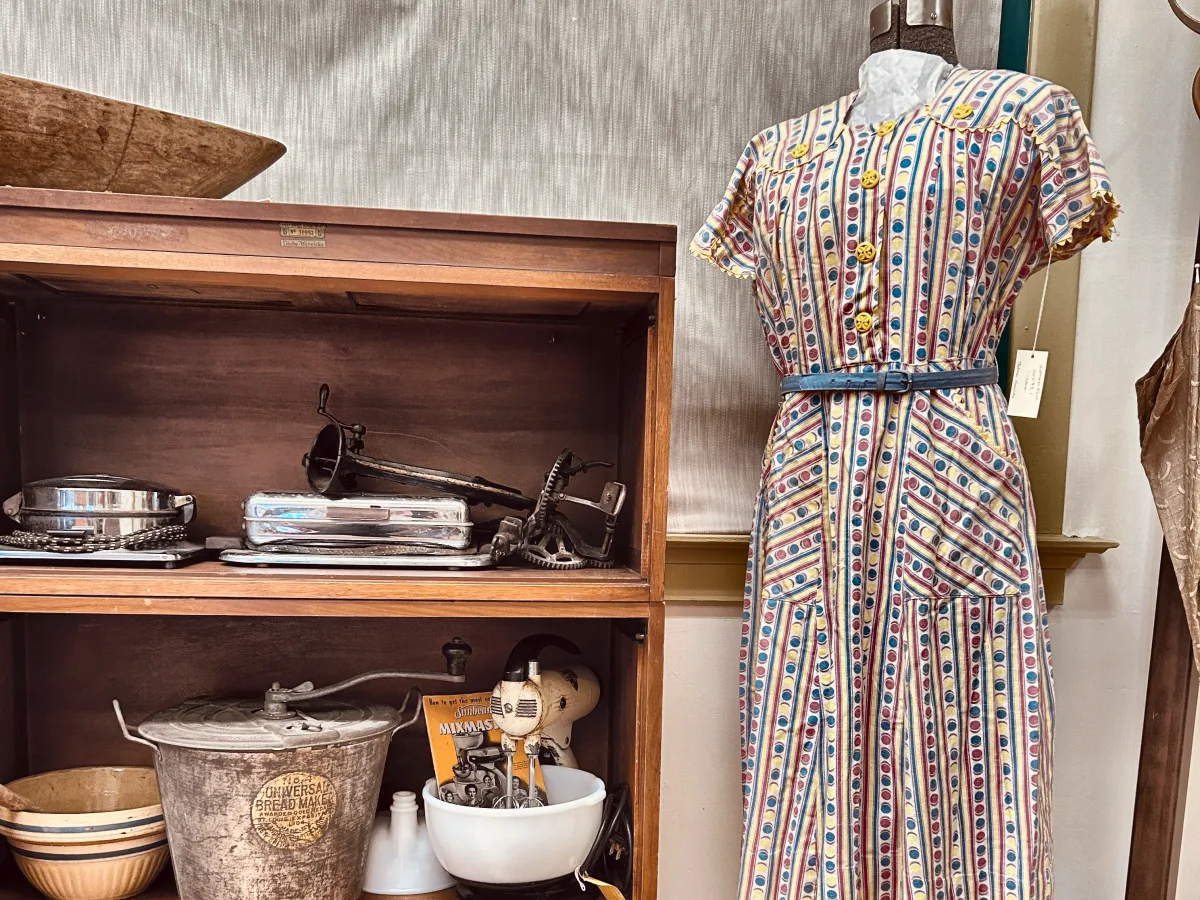
Shelves with a Universal bread maker, mixing bowls and a Sunbeam Mixmaster beside a printed cotton house dress
Bread by the bucketful. A Universal Bread Maker, gold medal winner at the St. Louis Exposition, with a crank lid and a four loaf capacity. Beside it a Sunbeam Mixmaster and a striped house dress.
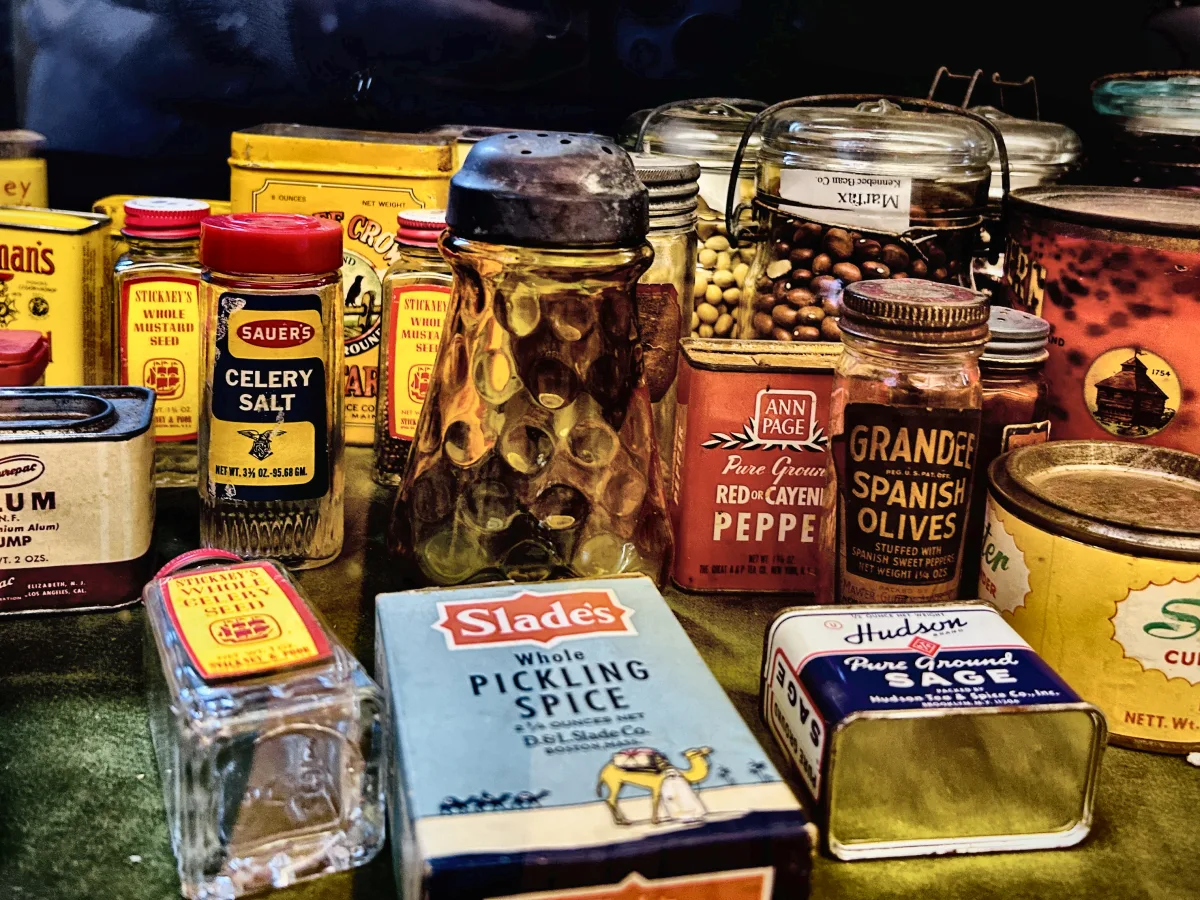
Crowded shelf of vintage spice tins, jars and boxes
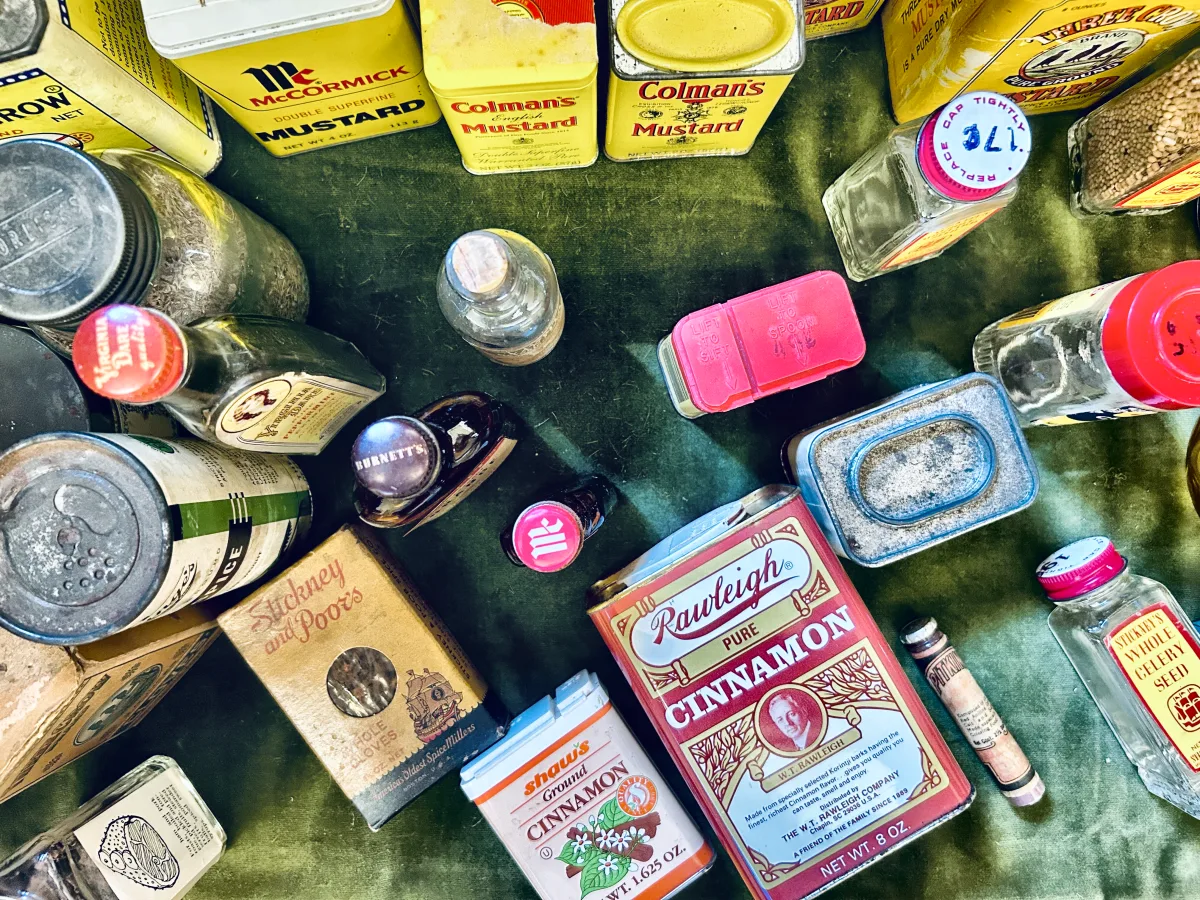
The spice shelf. Colman’s English Mustard, Stickney and Poor’s whole mustard seed out of Boston, Sauer’s celery salt, Slade’s pickling spice with its camel. A pantry assembled a tin at a time.
Overhead view of spice tins and bottles including Rawleigh cinnamon
Looking down on the pantry. A Rawleigh Pure Cinnamon tin carrying W. T. Rawleigh’s own portrait. Rawleigh men sold door to door, which is how half of this reached Vassalboro.
Columbia Grafonola phonograph cabinet with a guitar leaning against it
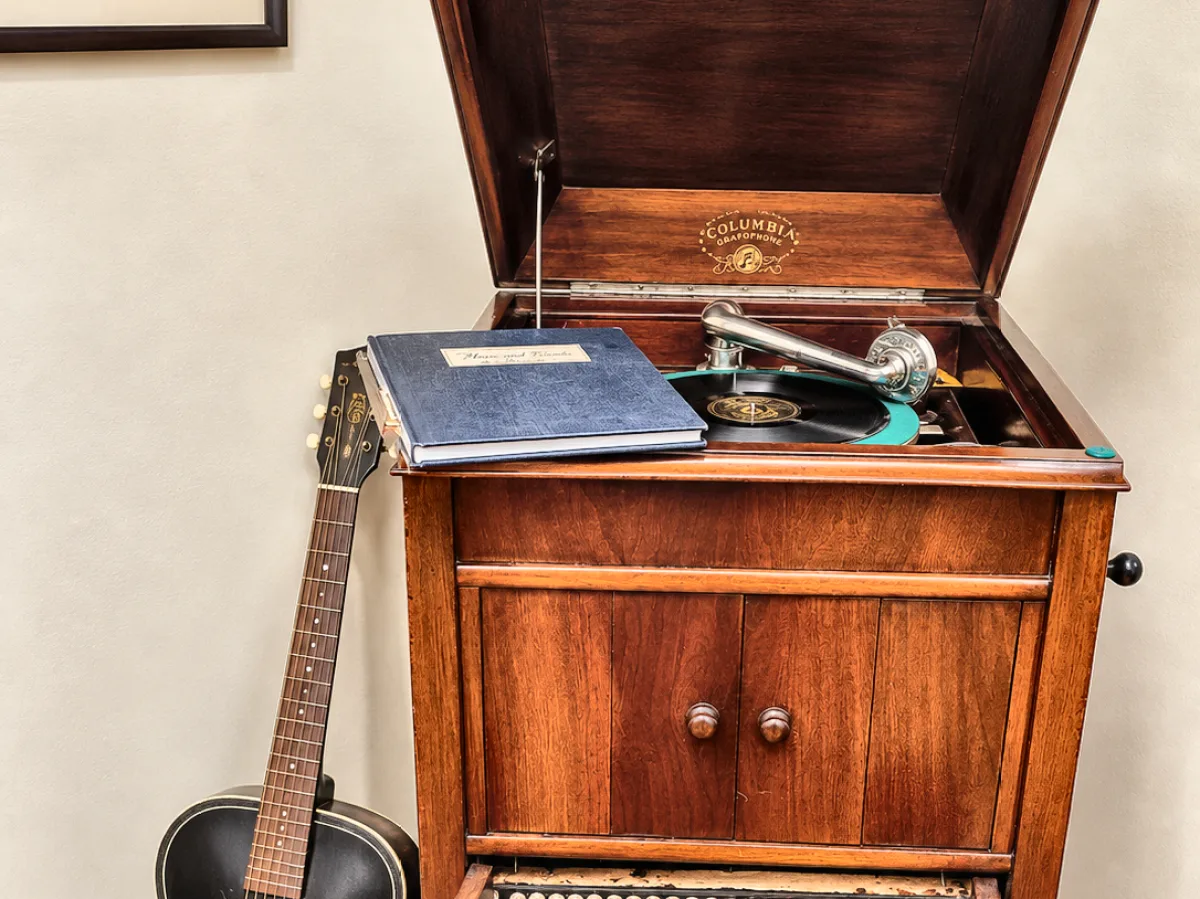
The Grafonola. Before radio reached this far up the Kennebec, an evening’s music came out of a cabinet like this one, cranked by hand, one side at a time.
Open Grafonola lid showing a record on the turntable and a typed provenance card
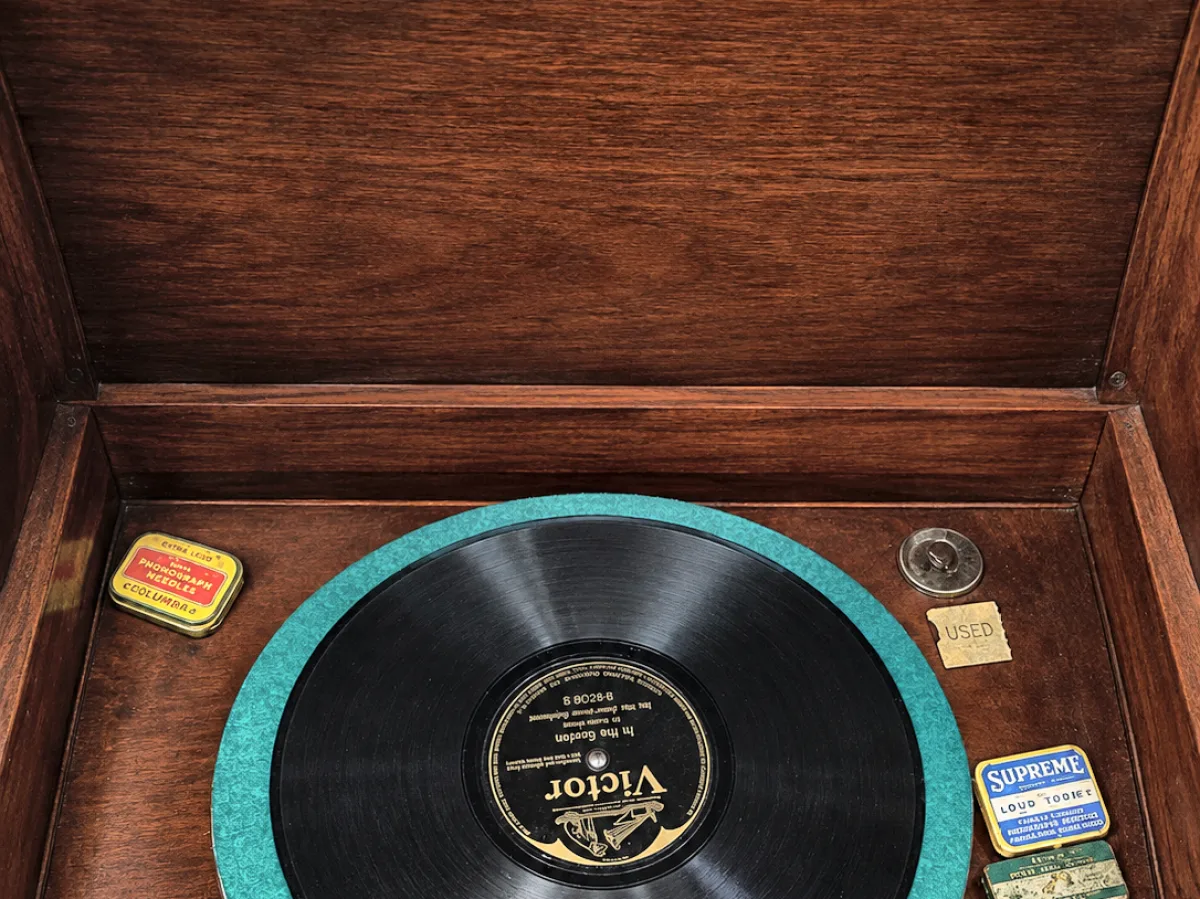
Saved twice. The card records that it came from the home of the late Ina Hussey of East Vassalboro, spent years in a damp basement with the veneer lifting, and was restored by Charles “Chuck” Ferguson.
Oak wall telephone from 1925 beside a framed telephone company directory page
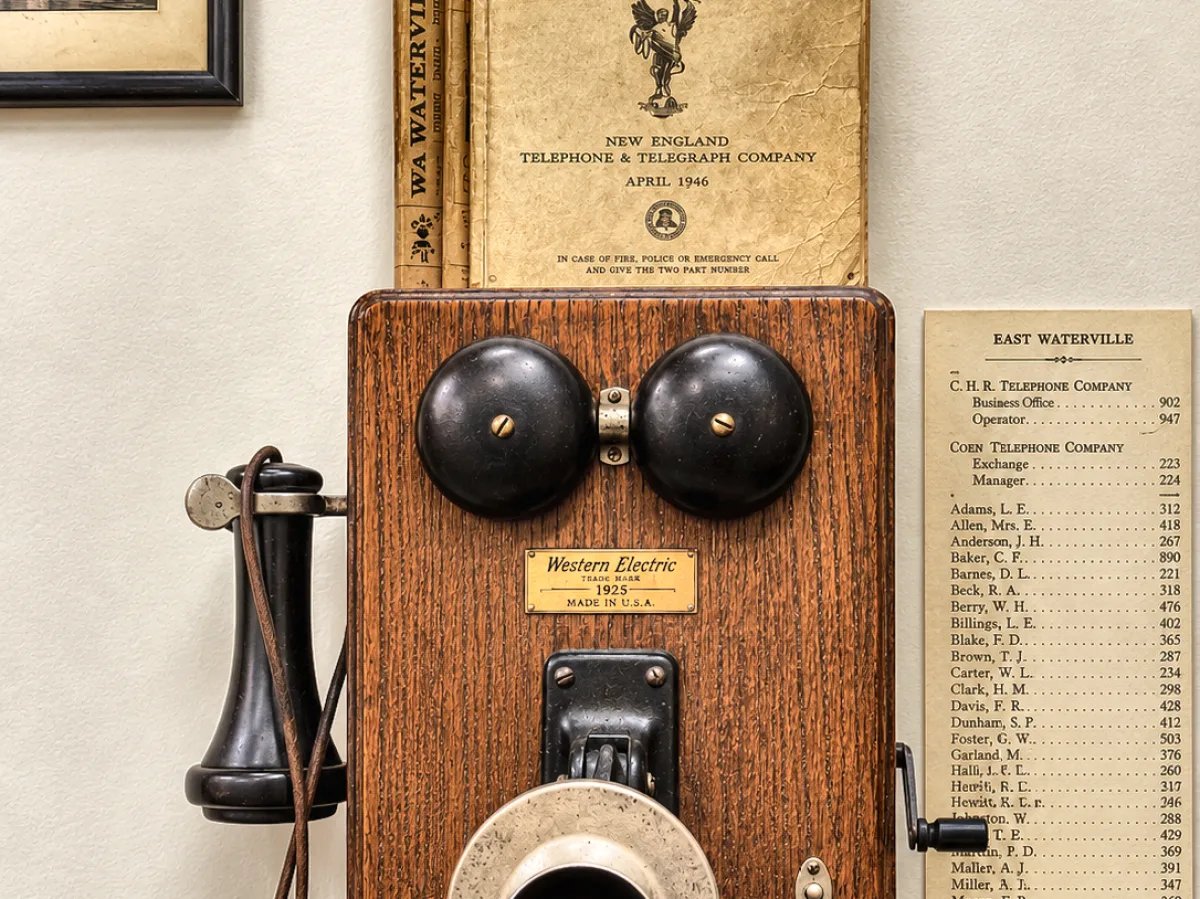
Number, please. A wall set of about 1925, crank on the side. The directory beside it lists Vassalboro numbers of three and four digits, because there were few enough subscribers.
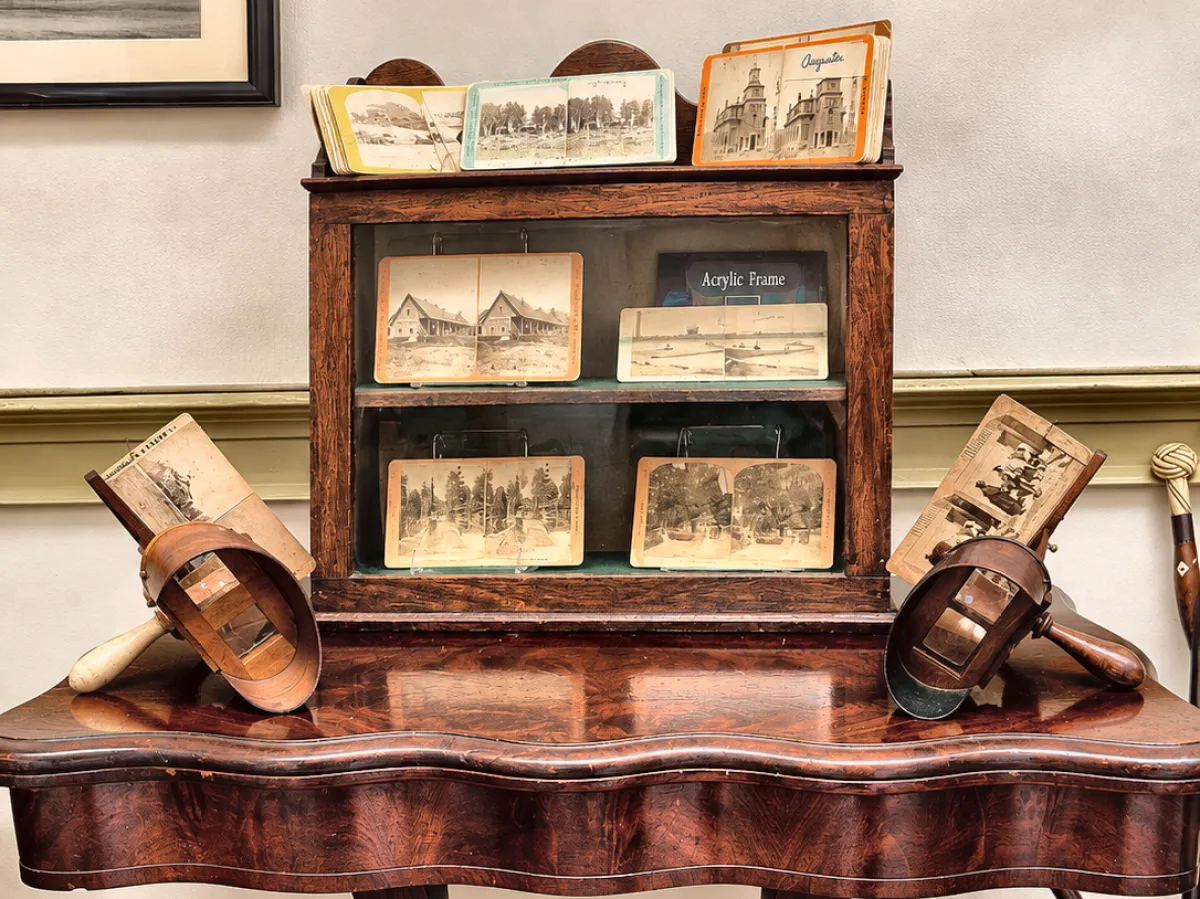
Card table holding a stereoscope cabinet, two viewers and rows of stereo view cards
Home entertainment, 1890. Two viewers and a cabinet of cards. The nearest thing a Vassalboro parlor had to travel.
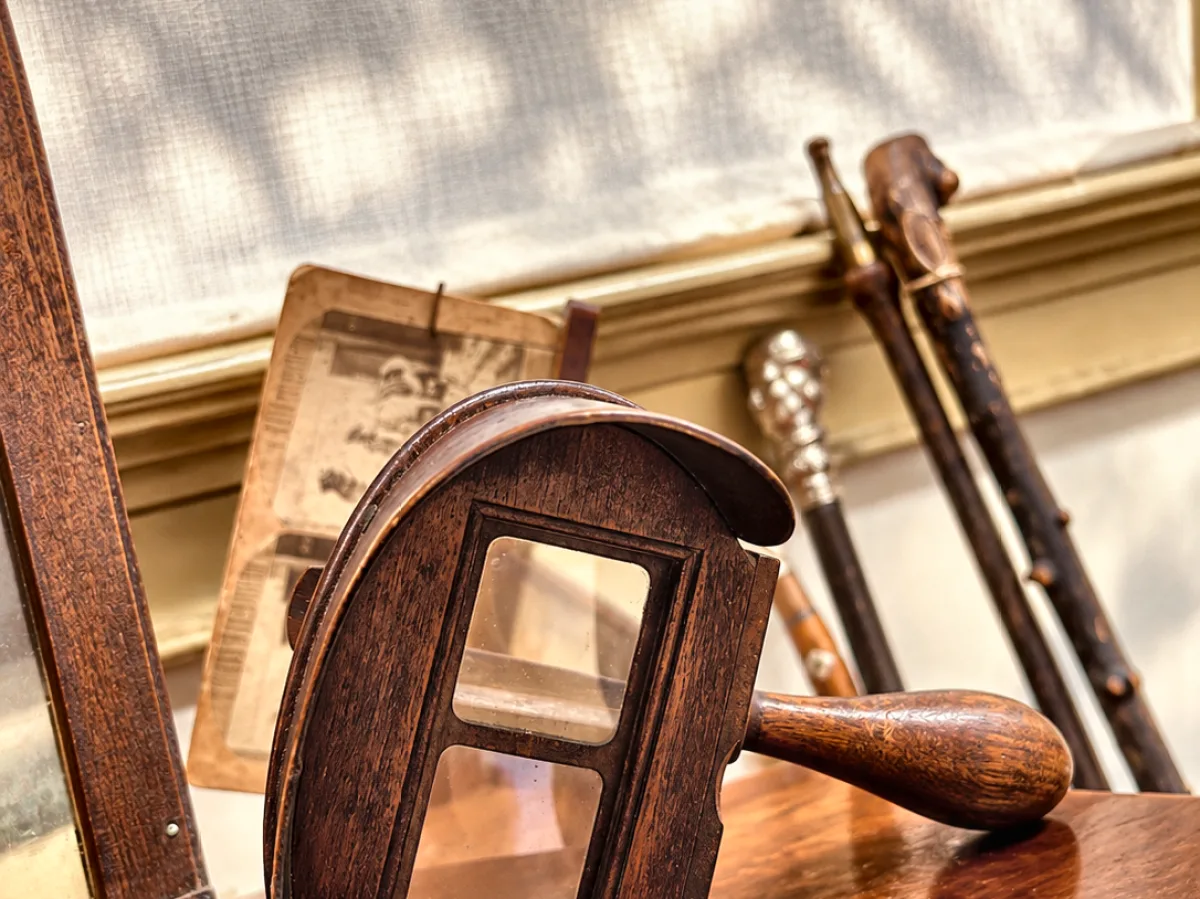
Wooden stereoscope viewer with a card held in its wire rack
How it worked. Each eye sees one of the paired photographs and the brain fuses them into a scene with depth. The hood blocks the room so there is nothing to look at but the view.
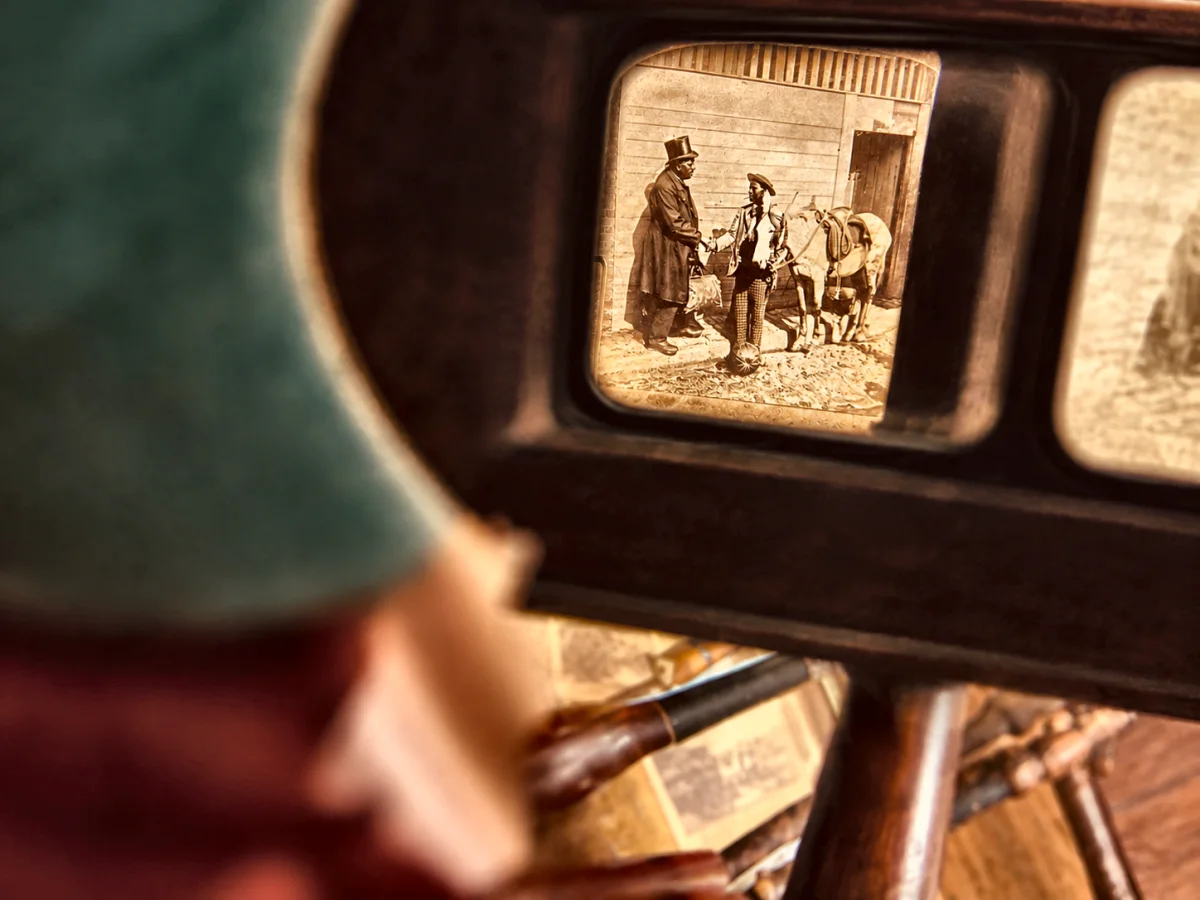
View through a stereoscope viewer showing a sepia card of a top hatted man and a groom with horses outside a stable
What you actually see. Looking through the viewer at a card of a gentleman in a top hat bargaining with a groom outside a stable. Two flat photographs, and then suddenly the horses stand behind the men.
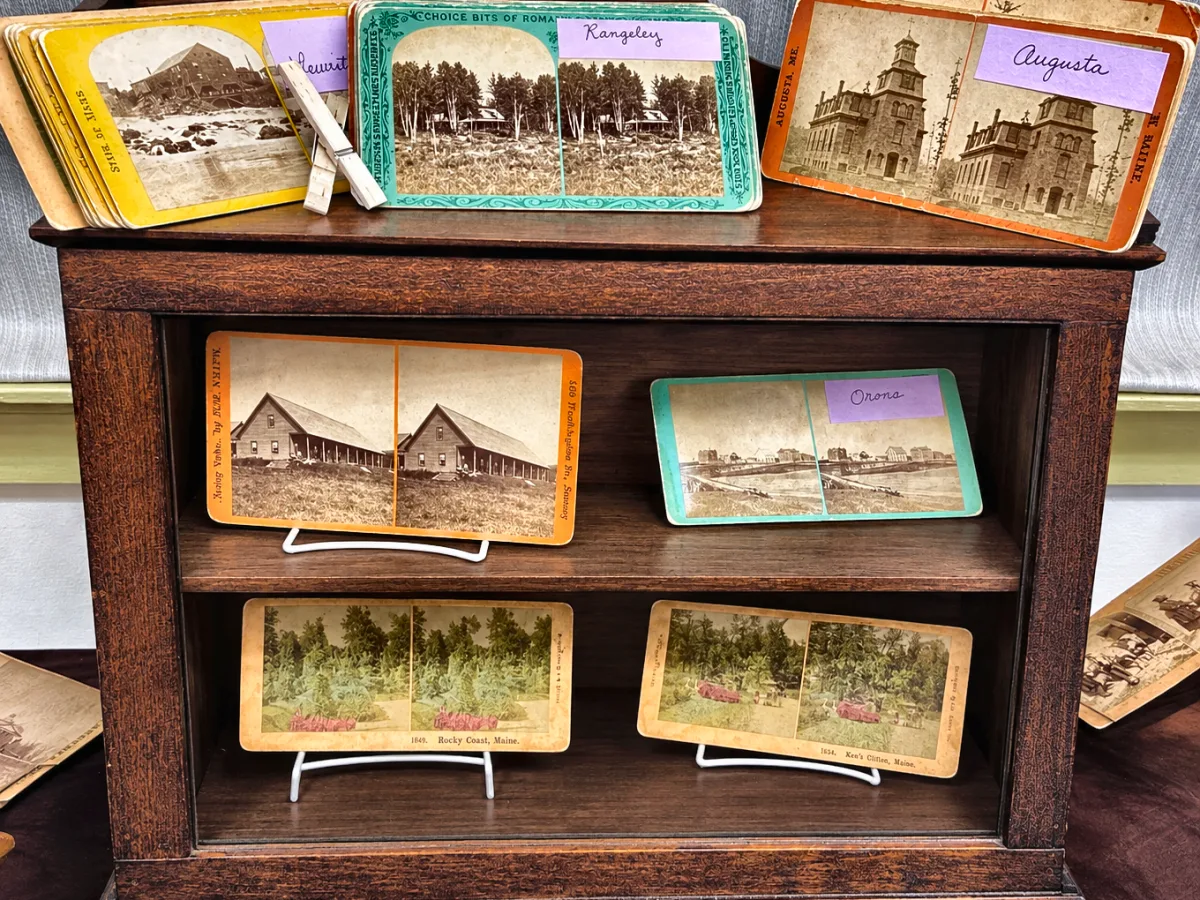
Stereo view cards showing Maine scenes including Augusta and the Rangeley Lakes
Where the cards went. Augusta, Orono, the Rangeley Lakes, Lewiston. Sold by subscription and traded between households, so a family that never left the county still knew the State House.
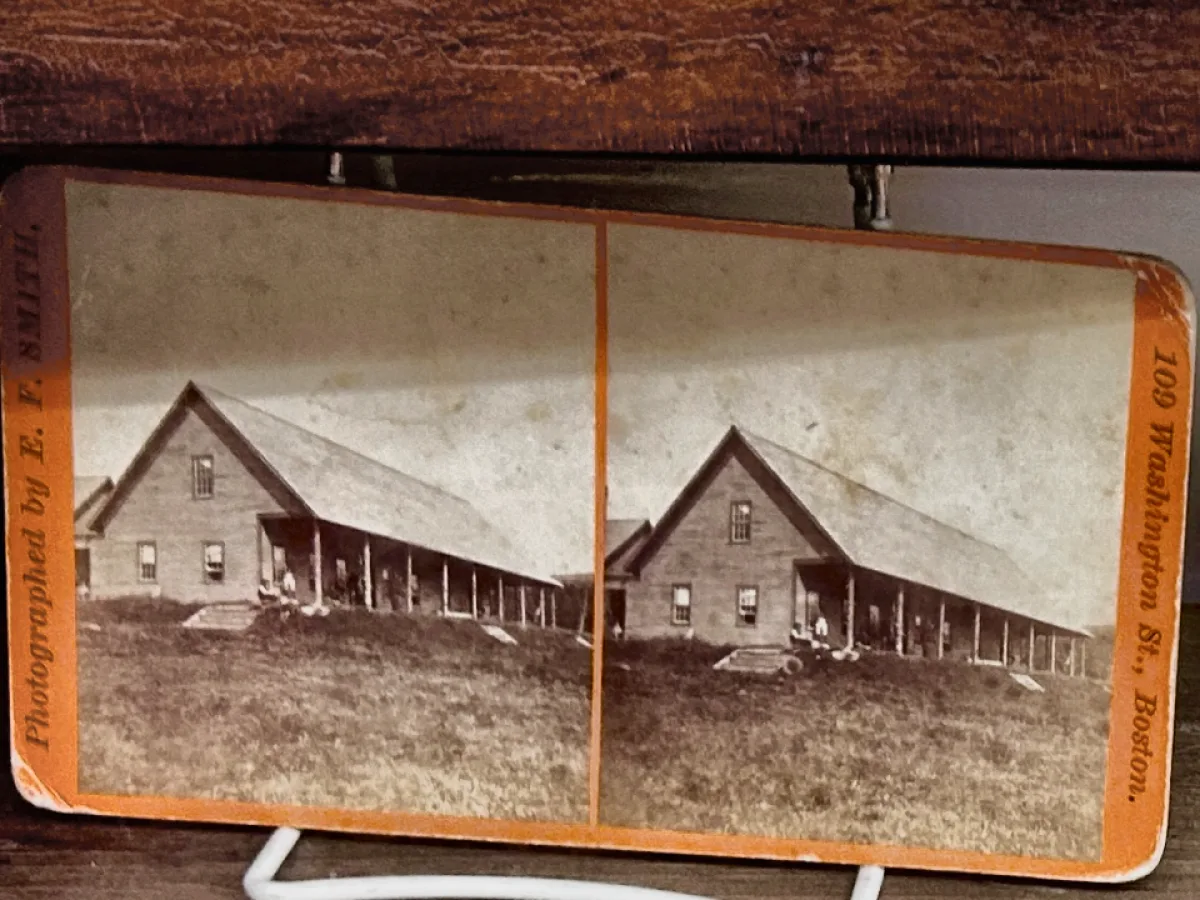
Orange mounted stereo view card of a Maine farmhouse, photographed by E. F. Smith of Boston
A farmhouse, twice. Photographed by E. F. Smith, 109 Washington Street, Boston. Two exposures a few inches apart, printed side by side.
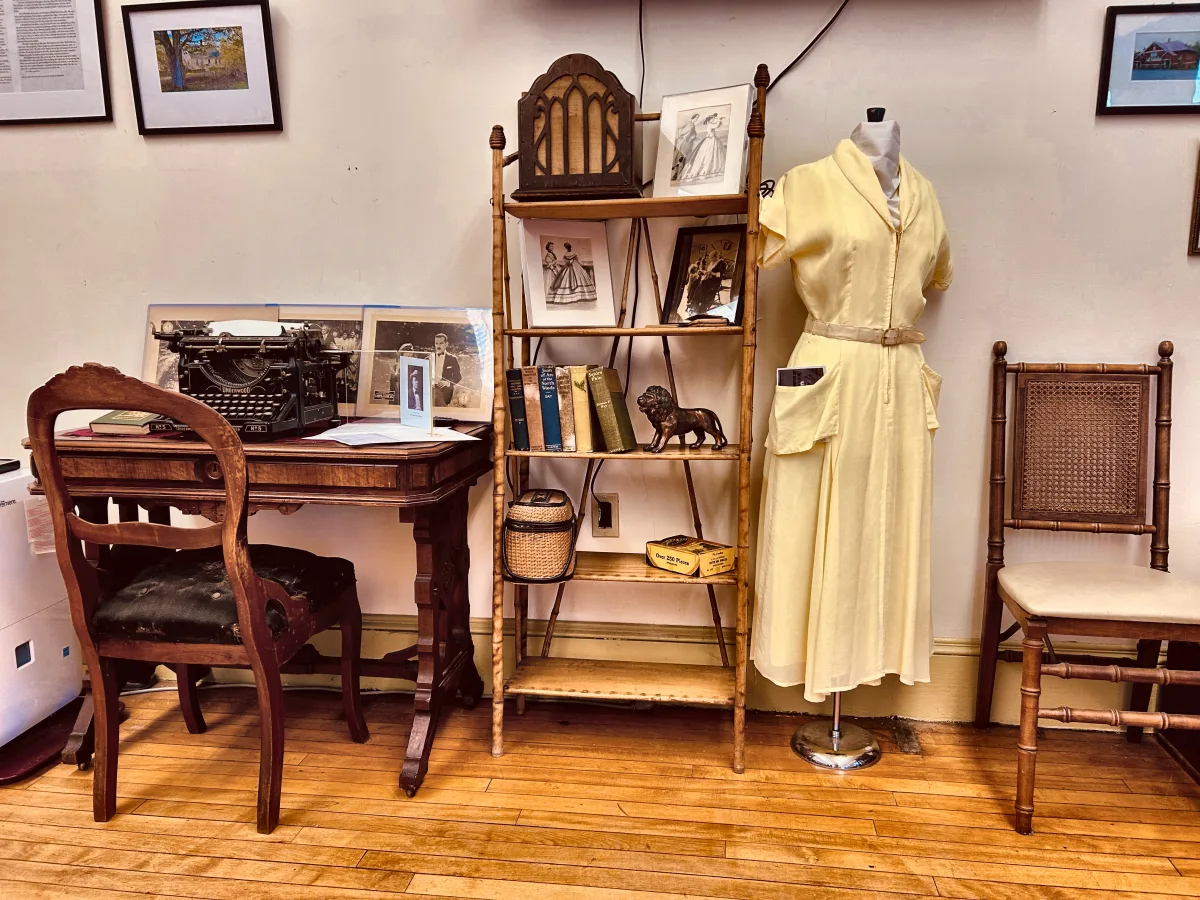
Underwood No. 5 typewriter on a parlor table beside a bamboo shelf and a pale yellow dress
The Underwood No. 5. The machine every later typewriter copied, with the type bars striking the front of the platen so the writer could finally see the line.
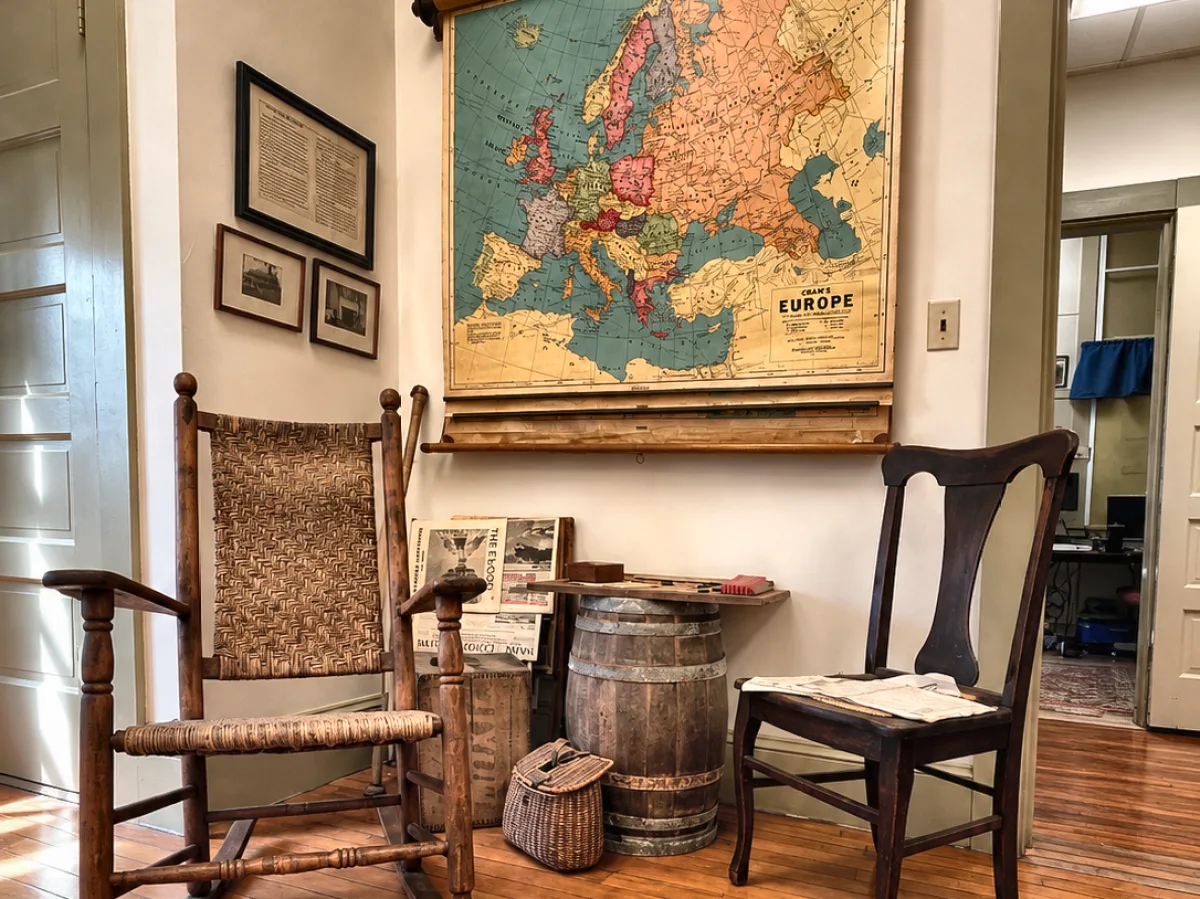
Cane seat rocking chair and side chairs beneath a roll down wall map of Europe
The corner where people sat. A cane seat rocker, two side chairs, and a wall map of the kind that hung in schoolrooms and parlors alike.
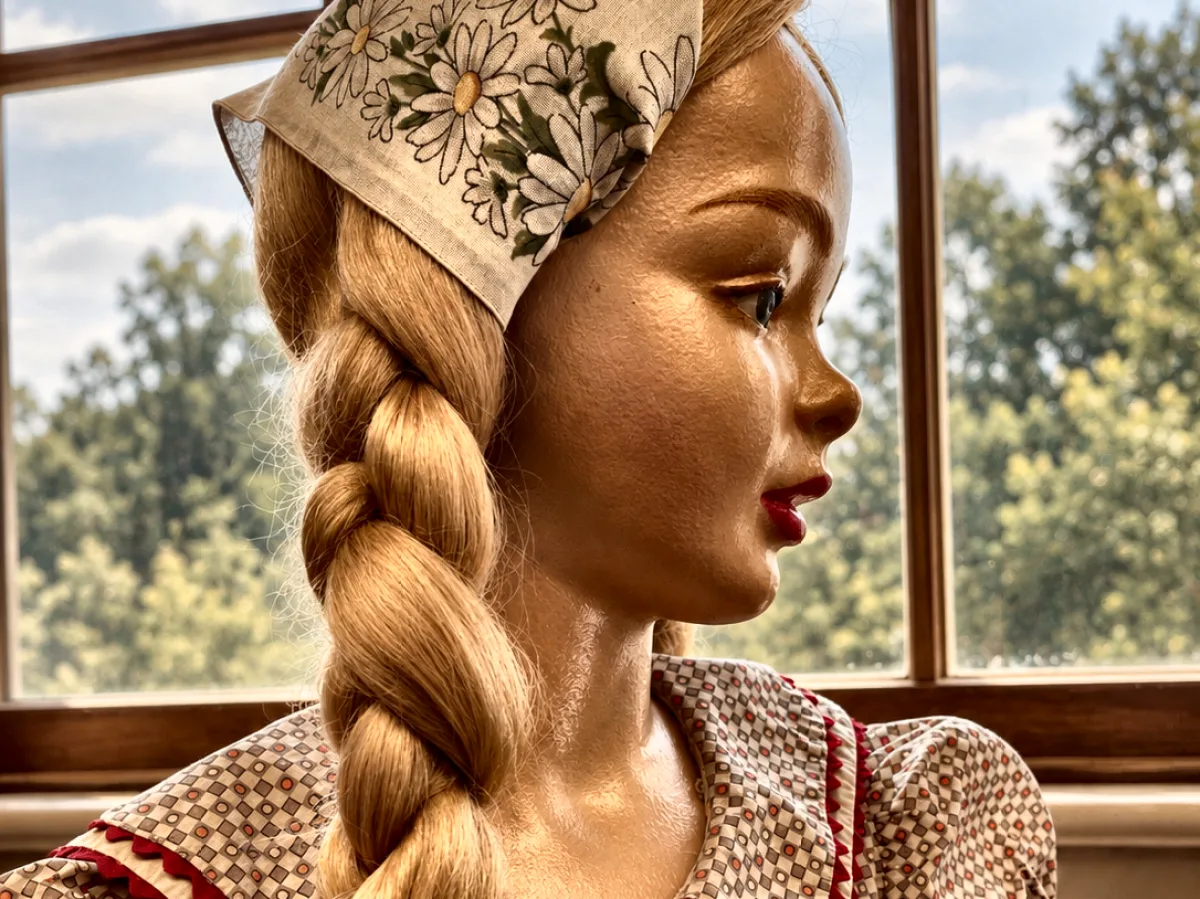
Doll with long blond braids, a flowered headdress and a checked dress
Braids and a flowered crown. Dressed with more care than most were, and kept long enough to reach a museum case.

Outside

The Community Quilt on the line
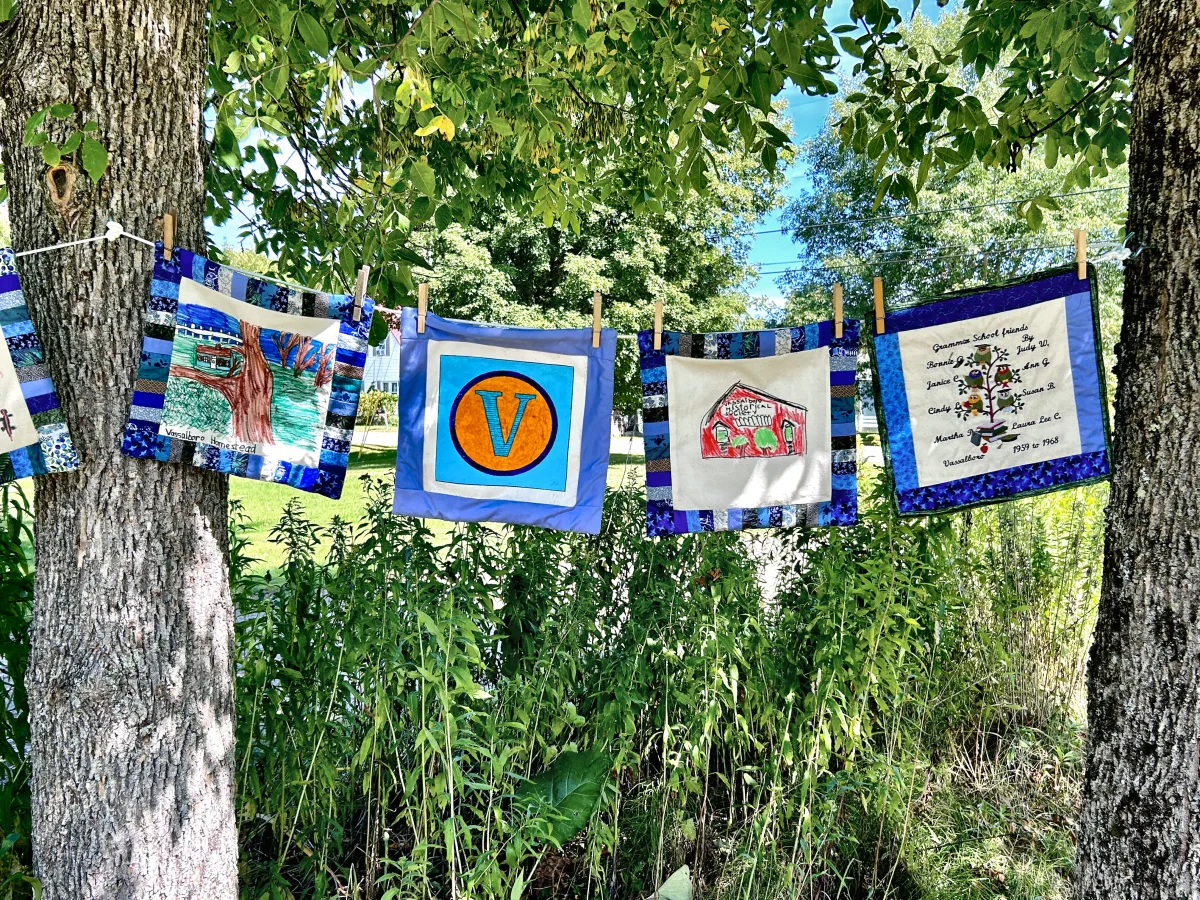
Community Quilt blocks pegged to a clothesline between two trees
The quilt on the line. Blocks pegged out between two trees for the weekend, which is how quilts were always aired and still the best way to see one.
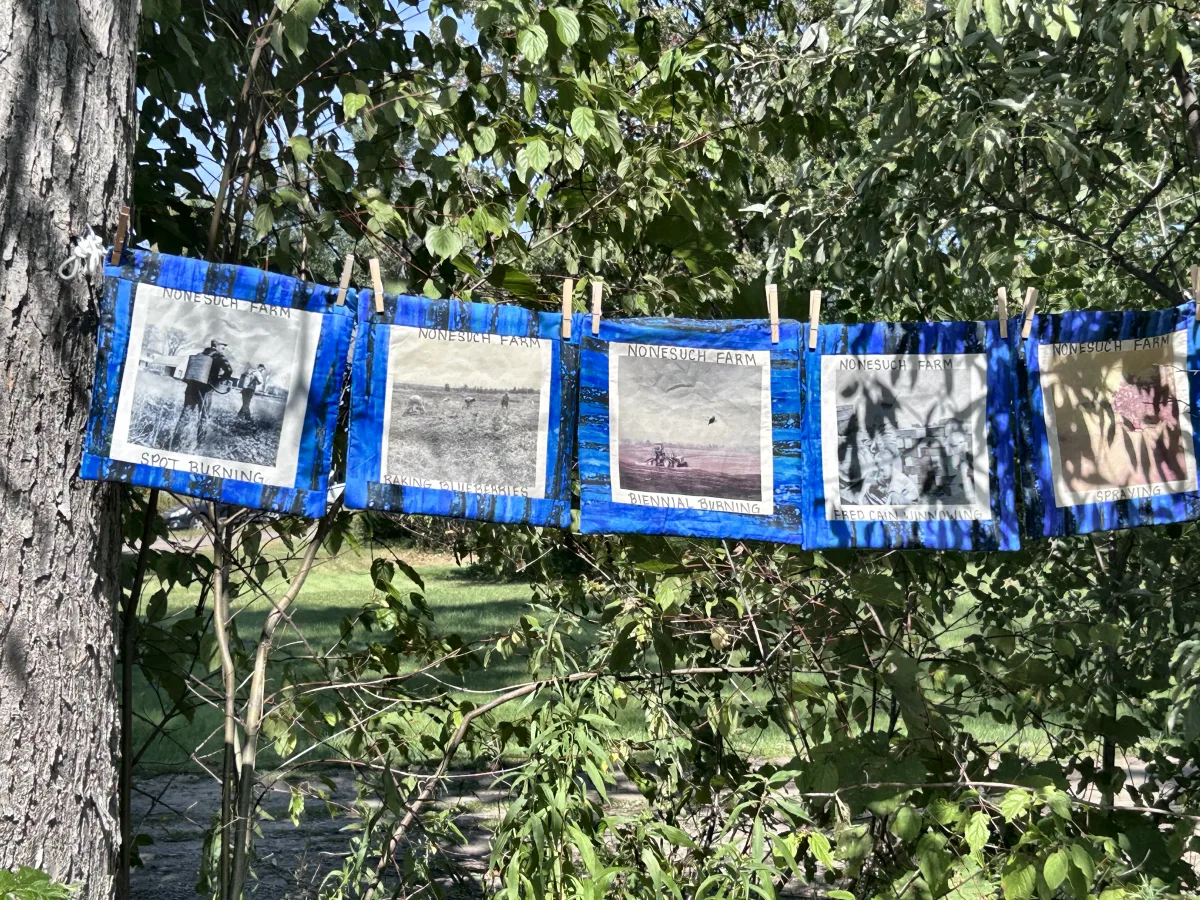
Five quilt blocks printed with photographs labelled Nonesuch Farm
Nonesuch Farm. Spot burning, raking blueberries, biennial burning, Fred Cain winnowing, spraying. A whole blueberry season in five blocks.
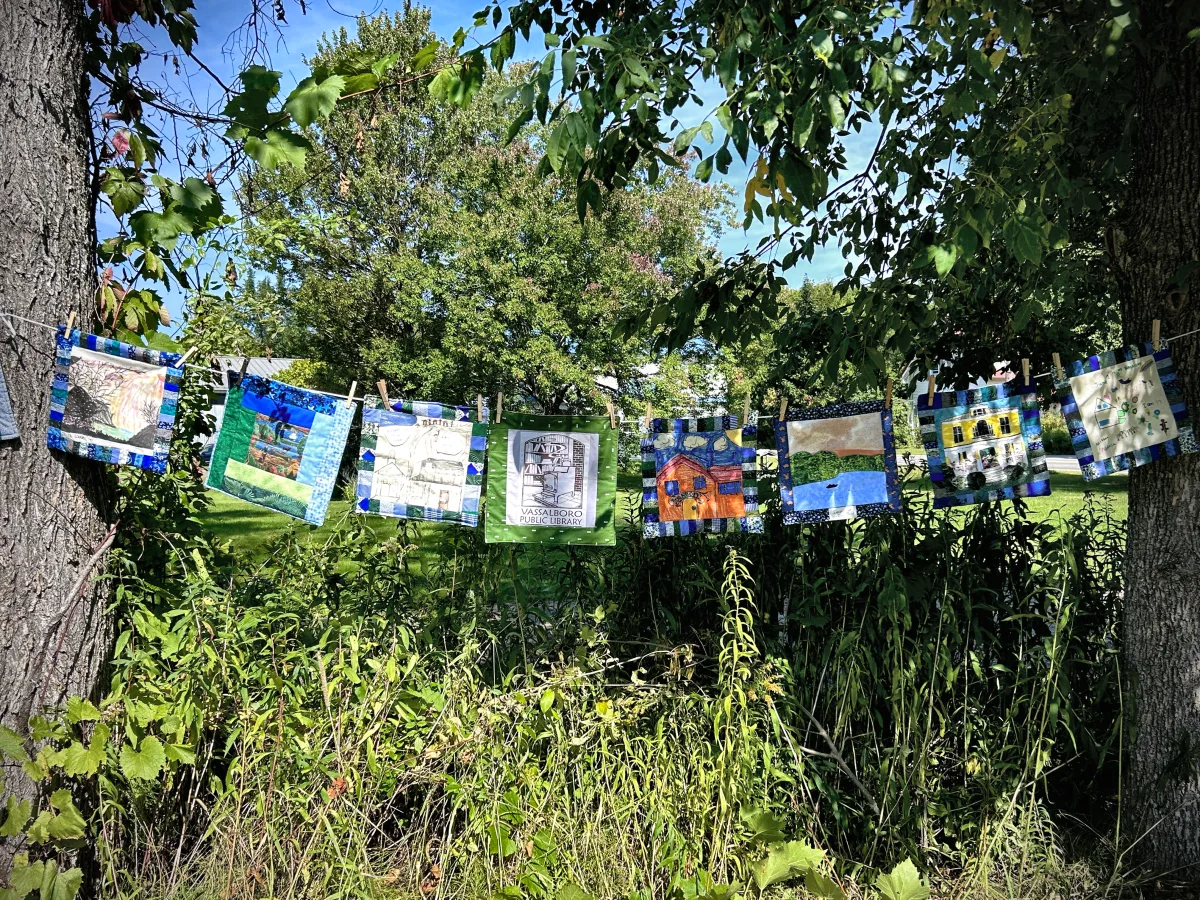
Quilt blocks on a clothesline including one showing the Vassalboro Public Library
Buildings people know. The library, the little red schoolhouse, the yellow house on the corner, made by people who pass them every day.
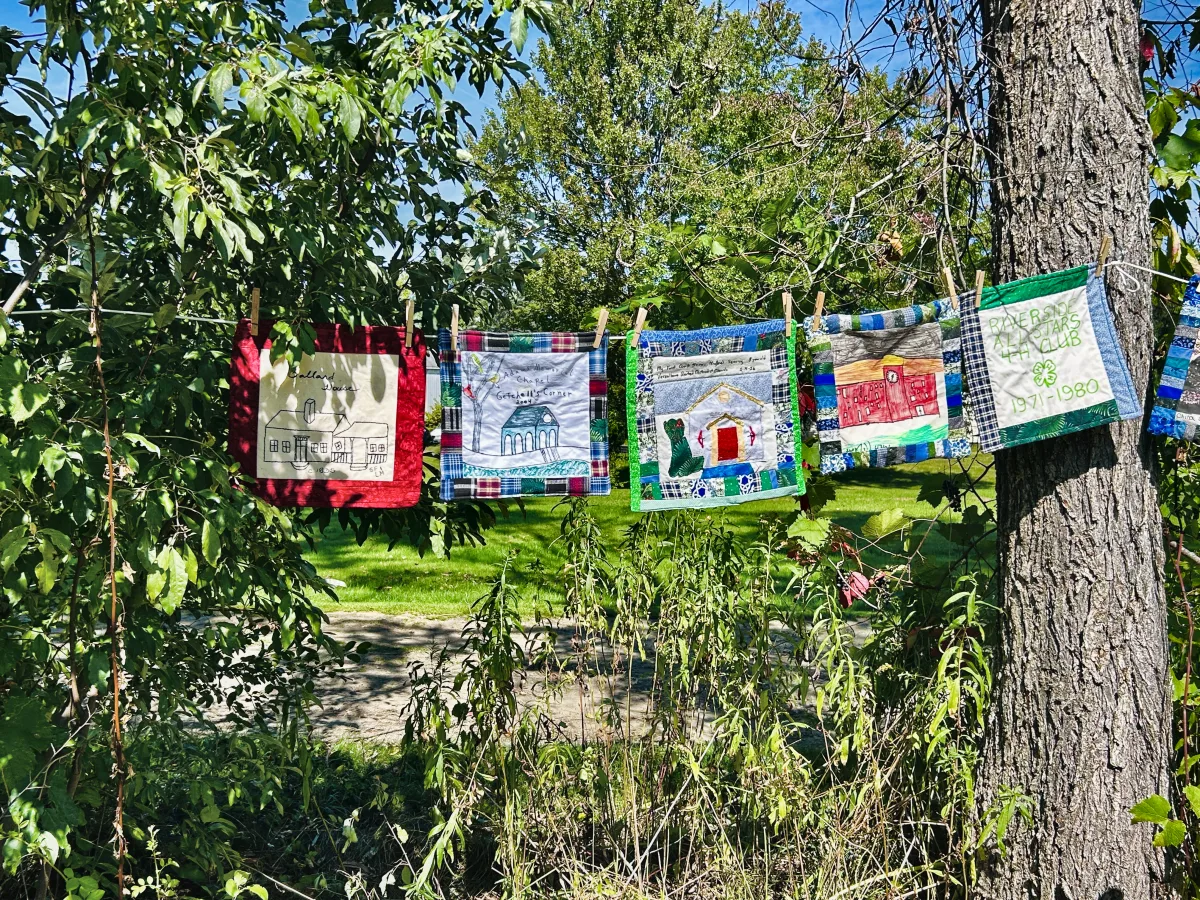
Quilt blocks showing the Ballard House, the Getchell’s Corner chapel and a Riverside All Stars 4-H block
Ballard House, and the 4-H. The Getchell’s Corner chapel, the Methodist church, and the Riverside All Stars, 1971 to 1980.
Recognize someone or something in these photographs, or can you tell us more about an object here? Write to vhspresident@gmail.com. If you would like a photograph removed, just say so and we will take care of it.